Fragment of a Segmentum with Palmette Tree (700s): Art, History and Details
Fragment of a Segmentum with Palmette Tree at the Cleveland Museum of Art: 700s, Silk: compound twill. Explore the work's context, creator attribution and collection history.
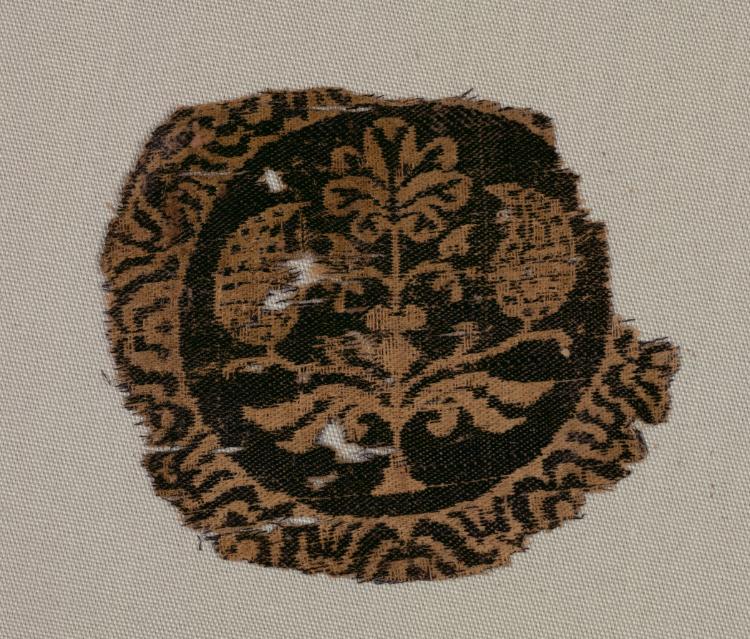
Fragment of a Segmentum with Palmette Tree (700s) is in the Cleveland Museum of Art collection.
The work and its context
The museum's open-access catalogue describes the work:
Originally, these luxurious silk roundels, each with at least three matching pieces, were cut and sewn onto the front and back of a tunic, probably linen, in Egypt. They belong to a sizeable group of comparable silk decorations found in Akhmim, Egypt. In each roundel, a stylized palmette tree is enclosed within a simplified lotus border which evolved from an ancient Egyptian lotus motif. These delicate silks were woven on large looms with automatic pattern repetition, called drawlooms. Dark blue and ivory silk horizontal wefts dominate, interlaced by vertical warps in a diagonal twill weave. A second inner warp does not come to the surface; one inner warp is visible between each interlacing warp. This compound weave, with two warps, is often called complementary weft twill with inner warps (samit).
Object facts
- Title: Fragment of a Segmentum with Palmette Tree
- Date: 700s
- Culture: Syria, Umayyad period (661–750) or Abbasid period (750–1258)
- Type: Textile
- Technique: Silk: compound twill
- Dimensions: Overall: 7.9 x 8.6 cm (3 1/8 x 3 3/8 in.); Mounted: 14 x 15.2 cm (5 1/2 x 6 in.)
- Collection: Textiles
- Department: Textiles
- Accession number: 1982.292
Collection credit
Purchase from the J. H. Wade Fund
View the collection record
See the museum's photographs and full catalogue entry. Catalogue text is reproduced from the Cleveland Museum of Art's open-access data, with HTML formatting removed. This object and its supplied image are designated CC0.
Sources
More in Lifestyle
Keep reading