Fragment of a Staff (late 1800s–early 1900s): Art, History and Details
Fragment of a Staff at the Cleveland Museum of Art: late 1800s–early 1900s, Wood, copper alloy, upholstery studs, and iron. Explore the work's context, creator attribution and collection history.
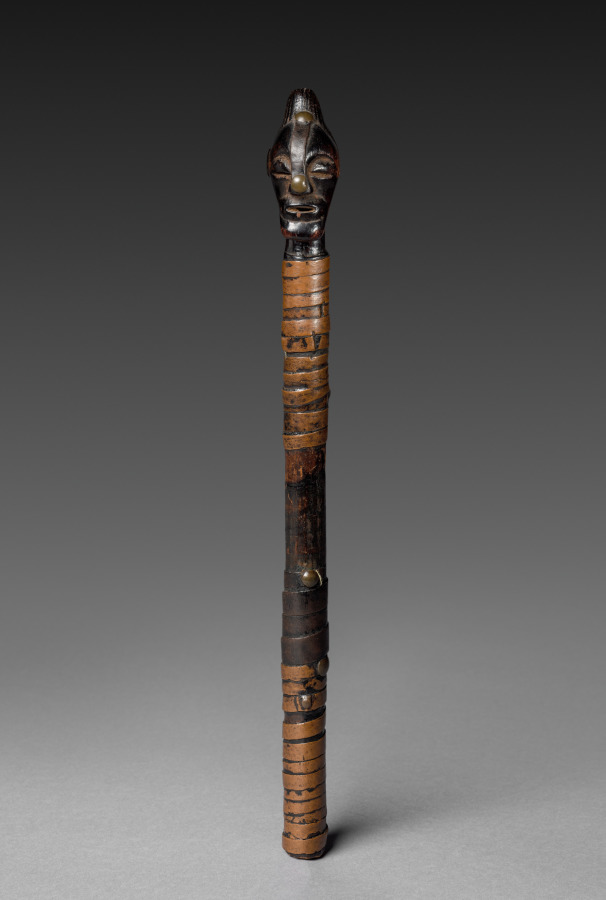
Fragment of a Staff (late 1800s–early 1900s) is in the Cleveland Museum of Art collection.
The work and its context
The museum's open-access catalogue describes the work:
Though modest in scale and fragmentary in that its blade is missing, this is perhaps one of the finest surviving examples of a sculptural object in the little-known style of the Kalundwe people. It represents a poorly documented culture's artistic style that sits between the Songye to the west and the Luba to the east. Showing surface traces of continuous manipulation, the shaft of this short staff is entirely wrapped with a copper sheet, a common feature of rank emblems. Originally, it would have had an iron blade projecting from its mouth. However, rather than serving as a functional tool for carving, it would be hung over the shoulder to signal the high rank of its owner, be it a chief, another dignitary, or even a sculptor.
Object facts
- Title: Fragment of a Staff
- Date: late 1800s–early 1900s
- Culture: Africa, Central Africa, Democratic Republic of the Congo, Kalundwe, unknown maker
- Type: Tools and Equipment
- Technique: Wood, copper alloy, upholstery studs, and iron
- Dimensions: Overall: 34.5 x 3.2 x 5.4 cm (13 9/16 x 1 1/4 x 2 1/8 in.)
- Collection: African Art
- Department: African Art
- Accession number: 2016.11
Collection credit
Gift of Kim Sherwin
View the collection record
See the museum's photographs and full catalogue entry. Catalogue text is reproduced from the Cleveland Museum of Art's open-access data, with HTML formatting removed. This object and its supplied image are designated CC0.
Sources
More in Lifestyle
Keep reading
Related stories