Fragment of a Tunic (400s–600s CE): Art, History and Details
Fragment of a Tunic at the Cleveland Museum of Art: 400s–600s CE, wool: tabby ground, inwoven tapestry ornament. Explore the work's context, creator attribution and collection history.
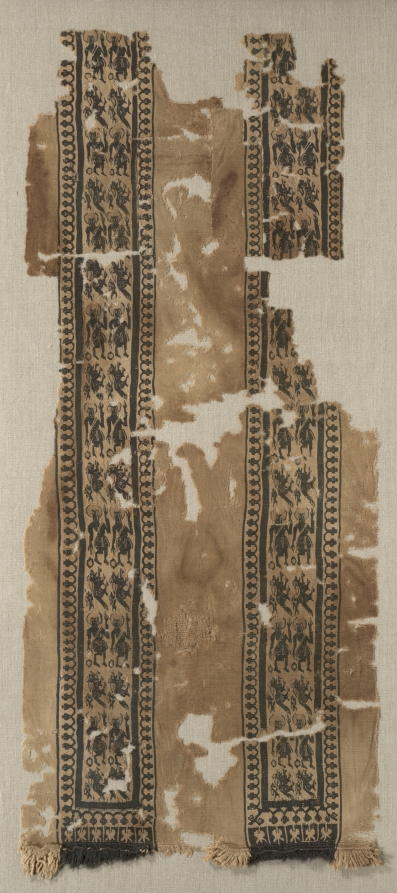
Fragment of a Tunic (400s–600s CE) is in the Cleveland Museum of Art collection.
The work and its context
The museum's open-access catalogue describes the work:
Tunics with decoration on the front and back were worn by both men and women. These long bands, called clavi, feature pairs of stylized haloed figures gesturing, possibly in dance, and wearing short skirts with scarves across their chests. They alternate with pairs of foxes (?) and fish. The ancient repair in the lower center of this woolen winter tunic reveals that decorated cloth was expensive, and thus often mended and reused.
Object facts
- Title: Fragment of a Tunic
- Date: 400s–600s CE
- Culture: Egypt, Byzantine period
- Type: Textile
- Technique: wool: tabby ground, inwoven tapestry ornament
- Dimensions: Overall: 94 x 39.4 cm (37 x 15 1/2 in.); Mounted: 99.7 x 48.3 cm (39 1/4 x 19 in.)
- Collection: T - Coptic
- Department: Textiles
- Accession number: 1926.143
A detail from the museum
The dark blue dye is made from indigo.
Collection credit
Gift of George D. Pratt
Further reading listed by the museum
- G. U. “Coptic Textiles.” The Bulletin of the Cleveland Museum of Art 13, no. 9 (1926).
View the collection record
See the museum's photographs and full catalogue entry. Catalogue text is reproduced from the Cleveland Museum of Art's open-access data, with HTML formatting removed. This object and its supplied image are designated CC0.
Sources
More in Lifestyle
Keep reading