Fragment of a Wall Decoration from the Palace of Xerxes: "Guardsman" in Procession (486–465 BCE): Art, History and Details
Fragment of a Wall Decoration from the Palace of Xerxes: "Guardsman" in Procession at the Cleveland Museum of Art: 486–465 BCE, gray limestone. Explore the work's context, creator attribution and collection history.
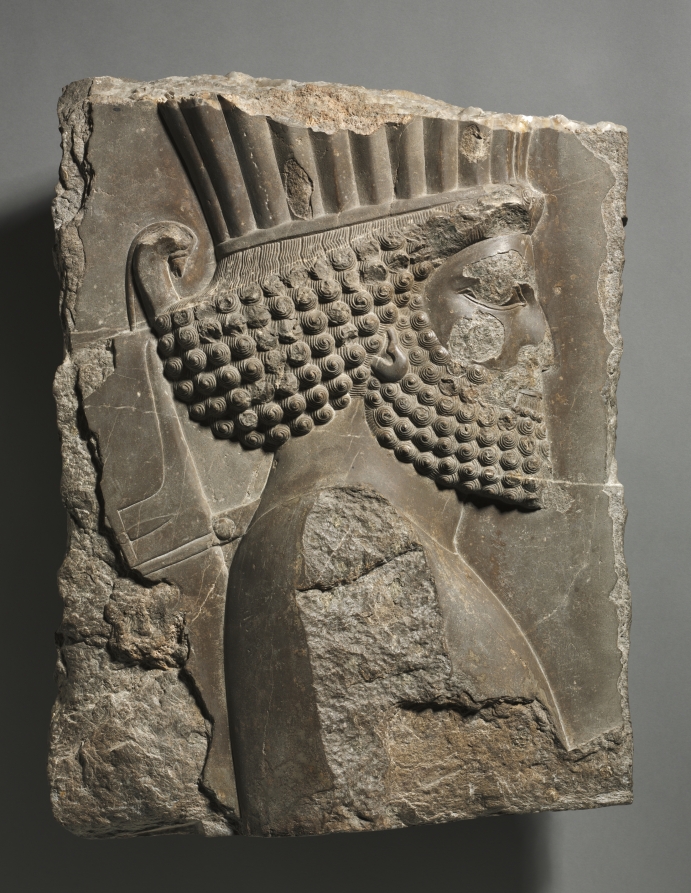
Fragment of a Wall Decoration from the Palace of Xerxes: "Guardsman" in Procession (486–465 BCE) is in the Cleveland Museum of Art collection.
The work and its context
The museum's open-access catalogue describes the work:
In 486 BC, Xerxes succeeded Darius I as king of Persia. His empire, then the world’s largest and most powerful, encompassed an area from Libya to western India and from Ethiopia to Afghanistan. This relief fragment of one of his guards probably comes from the west stairway of his enormous palace at Persepolis. As chronicled by Herodotus, the Greeks defeated Xerxes in a clash of conflicting political systems: democracy and monarchy.
Object facts
- Title: Fragment of a Wall Decoration from the Palace of Xerxes: "Guardsman" in Procession
- Date: 486–465 BCE
- Culture: Iran, Achaemenid (550–330 BCE), Persepolis
- Type: Sculpture
- Technique: gray limestone
- Dimensions: Overall: 53 x 43.6 cm (20 7/8 x 17 3/16 in.)
- Collection: Near Eastern Art
- Department: Egyptian and Ancient Near Eastern Art
- Accession number: 1943.279
A detail from the museum
This relief was probably once brightly painted.
Collection credit
Purchase from the J. H. Wade Fund
Further reading listed by the museum
- Hollis, Howard. “A Relief from Persepolis.” The Bulletin of the Cleveland Museum of Art 30, no. 9 (1943): 135–37.
- The Cleveland Museum of Art. The Cleveland Museum of Art Handbook. Cleveland, OH: The Cleveland Museum of Art, 1958.
- Lazuli, In Lapis, and Dorothy G. Shepherd. “An Achaemenid Sculpture.” The Bulletin of the Cleveland Museum of Art 48, no. 2 (February 1961): 19–25.
View the collection record
See the museum's photographs and full catalogue entry. Catalogue text is reproduced from the Cleveland Museum of Art's open-access data, with HTML formatting removed. This object and its supplied image are designated CC0.
Sources
More in Lifestyle
Keep reading