Fragment with crowned lions, palmettes, and escutcheons (1400s-1500s): Art, History and Details
Fragment with crowned lions, palmettes, and escutcheons at the Cleveland Museum of Art: 1400s-1500s, Silk: lampas weave. Explore the work's context, creator attribution and collection history.
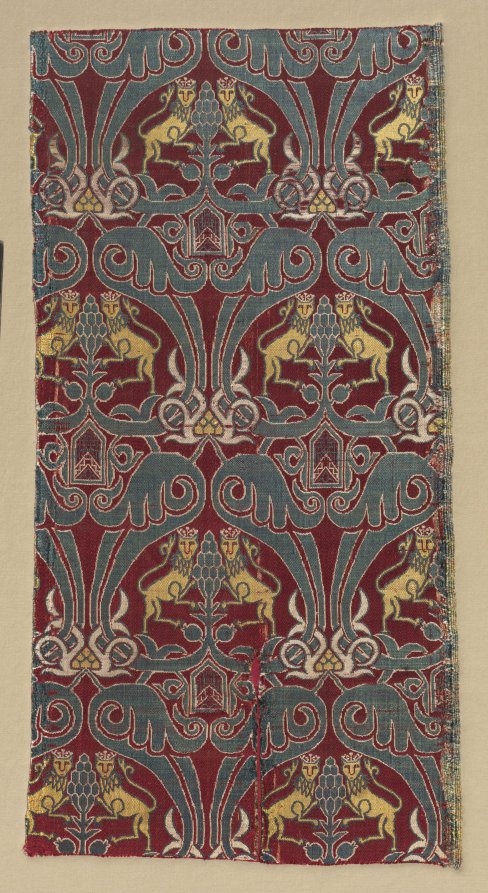
Fragment with crowned lions, palmettes, and escutcheons (1400s-1500s) is in the Cleveland Museum of Art collection.
The work and its context
The museum's open-access catalogue describes the work:
Pairs of yellow lions are framed beneath arches formed by elaborate green leaves in a sumptuous repeated pattern. The city of Granada in southern Spain, where the Alhambra palace stood, continued to be a major center for silk production and commerce through the 1500s. Because the upside-down shields contain no Arabic inscriptions, it was probably made after the fall of the last Muslim sultan to the Christian King Ferdinand and Queen Isabella in 1492.
Object facts
- Title: Fragment with crowned lions, palmettes, and escutcheons
- Date: 1400s-1500s
- Culture: Spain, Granada
- Type: Textile
- Technique: Silk: lampas weave
- Dimensions: Overall: 54.3 x 27.5 cm (21 3/8 x 10 13/16 in.); Mounted: 64.5 x 37.1 cm (25 3/8 x 14 5/8 in.)
- Collection: T - Islamic
- Department: Textiles
- Accession number: 1944.240
Collection credit
Purchase from the J. H. Wade Fund
Further reading listed by the museum
- Mackie, Louise W. Symbols of Power: Luxury Textiles from Islamic Lands, 7th-21st Century. Cleveland; New Haven: Cleveland Museum of Art; Yale University Press, 2015.
View the collection record
See the museum's photographs and full catalogue entry. Catalogue text is reproduced from the Cleveland Museum of Art's open-access data, with HTML formatting removed. This object and its supplied image are designated CC0.
Sources
More in Lifestyle
Keep reading