Fragment with Lion Strangler from a Dalmatic of Saint Bernard Calvo (1200–1243): Art, History and Details
Fragment with Lion Strangler from a Dalmatic of Saint Bernard Calvo at the Cleveland Museum of Art: 1200–1243, Silk and gold thread: lampas, taqueté, and plain-weave variant. Explore the work's context, creator attribution and collection hi
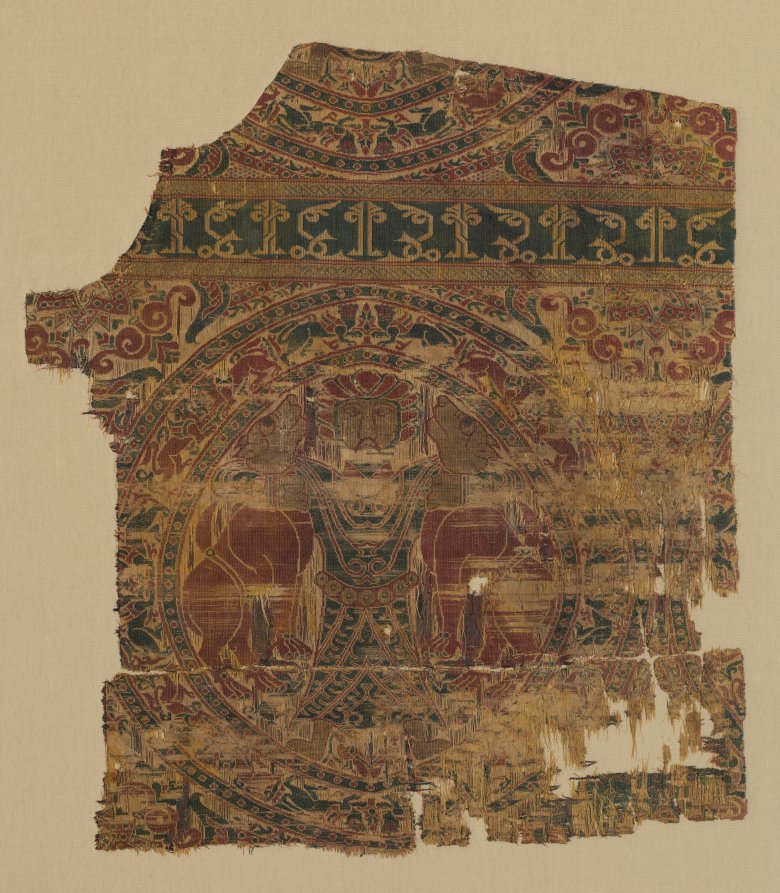
Fragment with Lion Strangler from a Dalmatic of Saint Bernard Calvo (1200–1243) is in the Cleveland Museum of Art collection.
The work and its context
The museum's open-access catalogue describes the work:
Within the elaborate roundel, a bearded man with a belted tunic strangles a lion in each hand. Gold thread shimmers on their heads and his hands. In the inscription band across the top, an Arabic word has been written with mirror-image symmetry. It can be read as al-yumn, primarily translated as prosperity. The central motif of this renowned silk is a pre- Islamic Persian symbol of royal power. Both Muslims and Christians throughout the Iberian Peninsula admired such textiles. Members of the Catholic clergy incorporated it into a dalmatic—a long ceremonial tunic. It was found in the late 1800s in the tomb of Saint Bernard Calvo, Bishop of Vich (1180–1243).
Object facts
- Title: Fragment with Lion Strangler from a Dalmatic of Saint Bernard Calvo
- Date: 1200–1243
- Culture: Spain, Almeria
- Type: Textile
- Technique: Silk and gold thread: lampas, taqueté, and plain-weave variant
- Dimensions: Overall: 43.8 x 39.7 cm (17 1/4 x 15 5/8 in.); Mounted: 53 x 49.8 cm (20 7/8 x 19 5/8 in.)
- Collection: T - Islamic
- Department: Textiles
- Accession number: 1950.146
Collection credit
Purchase from the J. H. Wade Fund
Further reading listed by the museum
- Shepherd, Dorothy G. "A Twelfth-Century Hispano-Islamic Silk." The Bulletin of the Cleveland Museum of Art 38, no. 3 (1951): 59-62.
- Shepherd, Dorothy. "Another Silk from the Tomb of Saint Bernard Calvo." The Bulletin of the Cleveland Museum of Art 38, no. 4 (April 1951): 74-75.
- Shepherd, Dorothy G. "A Dated Hispano-Islamic Silk." Ars Orientalis 2 (1957): 373-82.
View the collection record
See the museum's photographs and full catalogue entry. Catalogue text is reproduced from the Cleveland Museum of Art's open-access data, with HTML formatting removed. This object and its supplied image are designated CC0.
Sources
More in Lifestyle
Keep reading