Fragment with palmette arches with Alhambra wall pattern (1300s): Art, History and Details
Fragment with palmette arches with Alhambra wall pattern at the Cleveland Museum of Art: 1300s, Silk and gilt-metal thread: lampas weave. Explore the work's context, creator attribution and collection history.
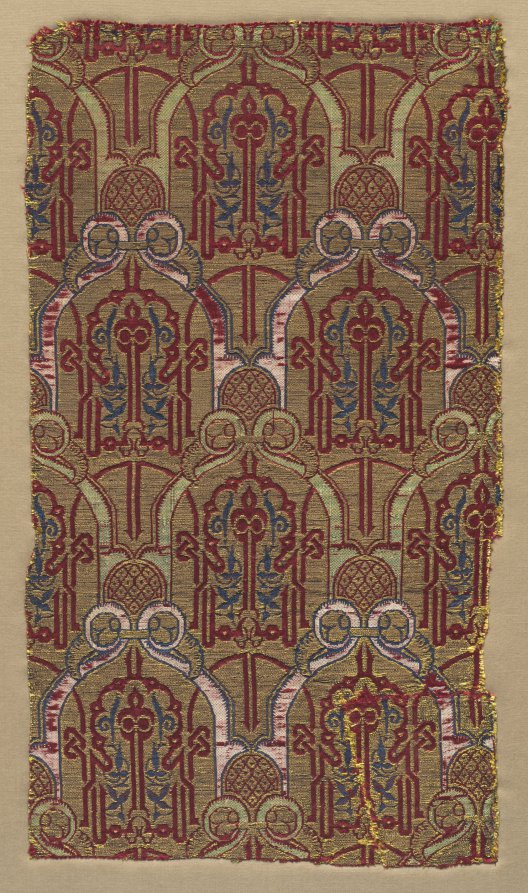
Fragment with palmette arches with Alhambra wall pattern (1300s) is in the Cleveland Museum of Art collection.
The work and its context
The museum's open-access catalogue describes the work:
This rare, gold-thread silk displays a sophisticated pattern that also decorates the stucco walls of the Alhambra, the imperial palace in Granada. Three superimposed designs form the harmonious pattern on the golden ground. Split-palmette leaves in ivory or green silk form staggered arches displaying a crimson text, Good fortune, written in angular Arabic script with extended strokes that create secondary symmetrical arches. Deep blue palmette leaves create the third level of decoration. The interior walls of the Alhambra would have shimmered with these warm, patterned textiles.
Object facts
- Title: Fragment with palmette arches with Alhambra wall pattern
- Date: 1300s
- Culture: Spain, Granada
- Type: Textile
- Technique: Silk and gilt-metal thread: lampas weave
- Dimensions: Overall: 48.3 x 25.4 cm (19 x 10 in.); Mounted: 58.1 x 35.2 cm (22 7/8 x 13 7/8 in.)
- Collection: T - Islamic
- Department: Textiles
- Accession number: 1939.35
Collection credit
Purchase from the J. H. Wade Fund
Further reading listed by the museum
- Underhill, Gertrude. “Textiles from Spain and Portugal Thirteenth to Sixteenth Centuries.” The Bulletin of the Cleveland Museum of Art 16, no. 10 (December 1929): 183–185, 191.
- Underhill, Gertrude. "Textiles from the H. A. Elsberg Collection." The Bulletin of the Cleveland Museum of Art 26, no. 9 (November 1939): 143–146.
- Los Angeles County Museum. 2000 Years of Silk Weaving: An Exhibition Sponsored by the Los Angeles County Museum in Collaboration with the Cleveland Museum of Art and the Detroit Institute of Arts. New York: E. Weyhe, 1944.
View the collection record
See the museum's photographs and full catalogue entry. Catalogue text is reproduced from the Cleveland Museum of Art's open-access data, with HTML formatting removed. This object and its supplied image are designated CC0.
Sources
More in Lifestyle
Keep reading