Fragments with Gold Foil (300s–400s CE): Art, History and Details
Fragments with Gold Foil at the Cleveland Museum of Art: 300s–400s CE, undyed linen, dyed wool, and gold foil; plain weave with supplementary weft-loops, slit-tapestry weave with supplementary weft wrapping. Explore the work's context, crea
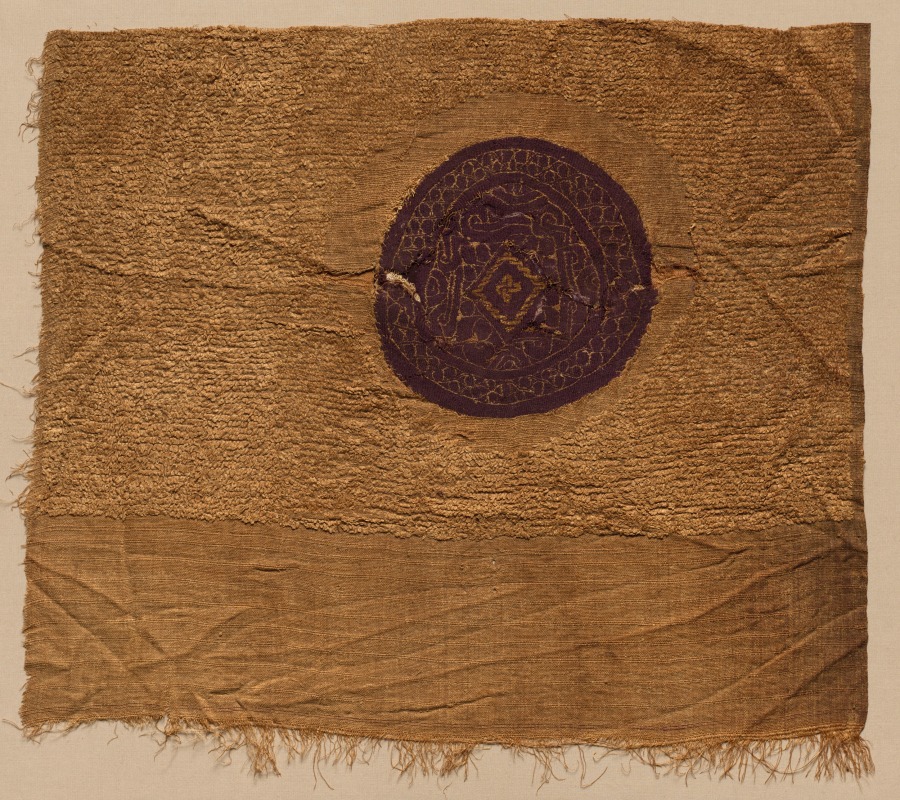
Fragments with Gold Foil (300s–400s CE) is in the Cleveland Museum of Art collection.
The work and its context
The museum's open-access catalogue describes the work:
The rare gold foil and rich purple wool in these two fragments originally enriched a luxurious fabric. Costly gold foil wrapped around a silk core forms the central motif within a diamond, woven in tapestry weave. The surrounding interlacing knot design—achieved with three overlapping squares (in the small fragment) or interlacing squares (in the large fragment)—offered protection from danger and harm. The roundels were woven with extra, or supplementary, linen wefts wrapped on the purple ground. Linen pile loops in the ground fabric resisted abrasion in furnishing fabrics and provided insulation in tunics.
Object facts
- Title: Fragments with Gold Foil
- Date: 300s–400s CE
- Culture: Egypt, Byzantine period
- Type: Textile
- Technique: undyed linen, dyed wool, and gold foil; plain weave with supplementary weft-loops, slit-tapestry weave with supplementary weft wrapping
- Dimensions: Average: 40.8 x 48.4 cm (16 1/16 x 19 1/16 in.)
- Collection: T - Coptic
- Department: Textiles
- Accession number: 1983.140
Collection credit
Purchase from the J. H. Wade Fund
Further reading listed by the museum
- Ball, Jennifer L.. "Charms: Protective and Auspicious Motifs." In Designing Identity: The Power of Textiles in Late Antiquity. Thelma K. Thomas, ed. Princeton: Princeton University Press, 2016.
View the collection record
See the museum's photographs and full catalogue entry. Catalogue text is reproduced from the Cleveland Museum of Art's open-access data, with HTML formatting removed. This object and its supplied image are designated CC0.
Sources
More in Lifestyle
Keep reading