Frieze Fragment with Chariot Procession (100s CE): Art, History and Details
Frieze Fragment with Chariot Procession at the Cleveland Museum of Art: 100s CE, stone carved in low relief with engraved detail. Explore the work's context, creator attribution and collection history.
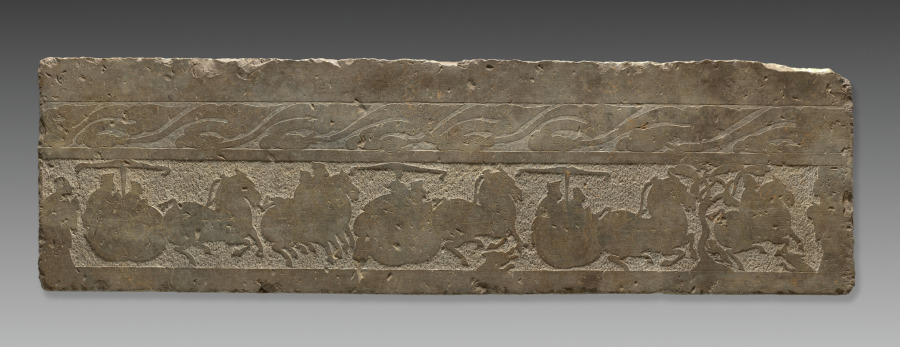
Frieze Fragment with Chariot Procession (100s CE) is in the Cleveland Museum of Art collection.
The work and its context
The museum's open-access catalogue describes the work:
The frieze shows a procession of horse-drawn chariots passing through terrain animated with wild animals and a monkey climbing a tree. The border of swirling clouds above conveys associations with heaven or the remote land of immortals in the high mountains. Comparable in style with the stone reliefs of the Wu Family shrines, this stone may have been originally carved for a local Eastern Han dynasty family tomb of similar status. To take a rubbing of the frieze, a moistened sheet of paper is laid over the slab and tamped with an ink pad that then darkens the raised areas, leaving concave sections and incised lines blank.
Object facts
- Title: Frieze Fragment with Chariot Procession
- Date: 100s CE
- Culture: China, style of Wu Family Shrines, Jiaxiang district, Shandong province, Eastern Han dynasty (25–220 CE)
- Type: Sculpture
- Technique: stone carved in low relief with engraved detail
- Dimensions: Overall: 48.3 x 166.4 x 13.3 cm (19 x 65 1/2 x 5 1/4 in.)
- Collection: China - Han Dynasty
- Department: Chinese Art
- Accession number: 1985.73
Collection credit
Andrew R. and Martha Holden Jennings Fund
Further reading listed by the museum
- C.T. Loo, Inc. Exhibition of Chinese Arts; Special Sale. New York: C.T. Loo & Co, 1941.
- Sotheby's, New York. Important Chinese Sculpture Sold for the Benefit of the J.T. Tai Foundation. 3 June 1985.
- Turner, Evan H. “The Year in Review for 1985.” The Bulletin of the Cleveland Museum of Art, vol. 73, no. 2, 1986, pp. 26–71.
View the collection record
See the museum's photographs and full catalogue entry. Catalogue text is reproduced from the Cleveland Museum of Art's open-access data, with HTML formatting removed. This object and its supplied image are designated CC0.
Sources
More in Lifestyle
Keep reading