Gateway Bracket (150–200 CE): Art, History and Details
Gateway Bracket at the Cleveland Museum of Art: 150–200 CE, sandstone. Explore the work's context, creator attribution and collection history.
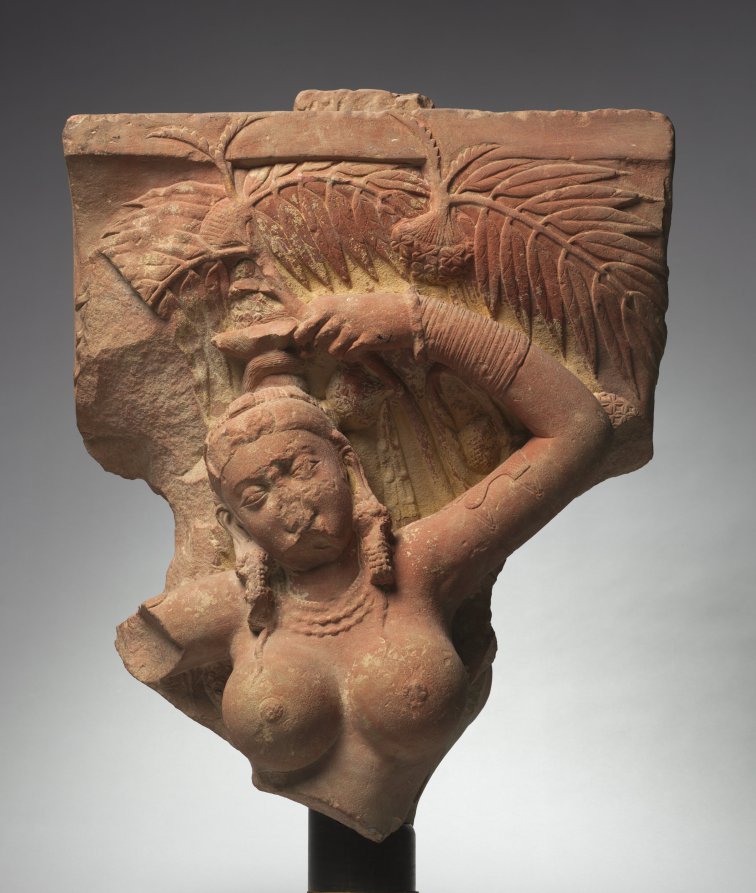
Gateway Bracket (150–200 CE) is in the Cleveland Museum of Art collection.
The work and its context
The museum's open-access catalogue describes the work:
Gateways leading into a sacred area often had large horizontal architraves, the weight of which was supported by brackets carved with figures of voluptuous women grasping the branch of a tree. They embody the ideal form of the young mother, with breasts full of nourishing milk. As personifications of the sap that pervades living plants, they are auspicious markers of life and abundance. These attractive figures, who embody the purifying water essential for life, symbolically cleanse visitors as they enter the sacred space. On both sides of this large bracket they grasp the branch of an ashoka tree, which has clusters of flowers that are bright red in nature.
Object facts
- Title: Gateway Bracket
- Date: 150–200 CE
- Culture: India, Mathura, Kushan period
- Type: Sculpture
- Technique: sandstone
- Dimensions: Overall: 73.9 x 57.2 cm (29 1/8 x 22 1/2 in.)
- Collection: Indian Art - Kushan, Mathura
- Department: Indian and Southeast Asian Art
- Accession number: 1971.15
Collection credit
John L. Severance Fund
Further reading listed by the museum
- Fricke, Berthold. The Cleveland Museum of Art. Hannover: Knorr & Hirth, 1970.
- Lee, Sherman E. "The Year in Review for 1971." The Bulletin of the Cleveland Museum of Art 59, no. 1 (1972): 3-46.
- Czuma, Stanislaw. “Mathura Sculpture in the Cleveland Museum Collection.” The Bulletin of the Cleveland Museum of Art, vol. 64, no. 3, 1977, pp. 83–114.
View the collection record
See the museum's photographs and full catalogue entry. Catalogue text is reproduced from the Cleveland Museum of Art's open-access data, with HTML formatting removed. This object and its supplied image are designated CC0.
Sources
More in Lifestyle
Keep reading