Geese, Reeds, and Water (1800s): Art, History and Details
Geese, Reeds, and Water at the Cleveland Museum of Art: 1800s, One of a pair of four-panel folding screens; ink, color, and cut gold foil on paper. Explore the work's context, creator attribution and collection history.
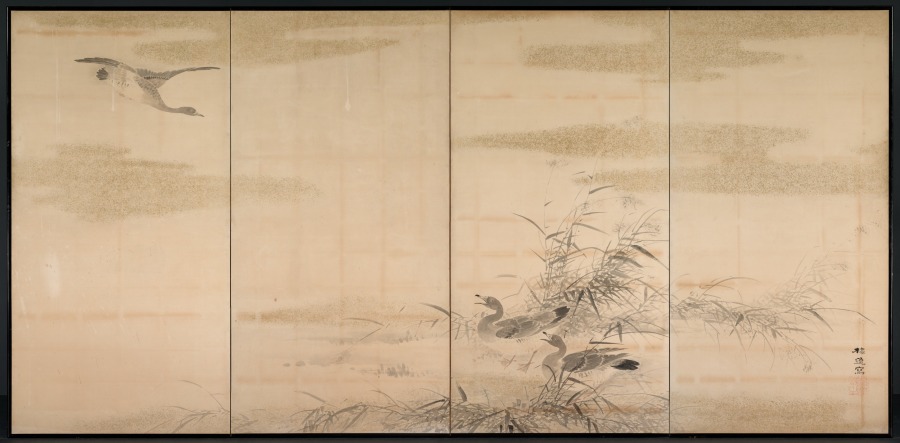
Geese, Reeds, and Water (1800s) is in the Cleveland Museum of Art collection. The museum's creator attribution is Yamamoto Baiitsu (Japanese, 1783–1856).
The work and its context
The museum's open-access catalogue describes the work:
This byōbu composition differs from most in that it comprises two four-panel screens, rather than two six-panel units. Since the current mounting is modern, it is impossible to determine whether its present configuration represents its original design. Some panels may have been removed to help the screens better fit into a modern interior space. Baiitsu worked almost exclusively in monochromatic ink tones and favored classical Chinese painting themes.
Object facts
- Title: Geese, Reeds, and Water
- Date: 1800s
- Creator attribution: Yamamoto Baiitsu (Japanese, 1783–1856)
- Culture: Japan, Edo period (1615–1868)
- Type: Painting
- Technique: One of a pair of four-panel folding screens; ink, color, and cut gold foil on paper
- Dimensions: Image: 169 x 350.5 cm (66 9/16 x 138 in.)
- Collection: ASIAN - Folding screen
- Department: Japanese Art
- Accession number: 1997.109.1
Collection credit
Bequest of Mrs. A. Dean Perry
Further reading listed by the museum
- Cunningham, Michael R. Unfolding Beauty: Japanese Screens from the Cleveland Museum of Art. Cleveland, OH: Cleveland Museum of Art, 2001.
View the collection record
See the museum's photographs and full catalogue entry. Catalogue text is reproduced from the Cleveland Museum of Art's open-access data, with HTML formatting removed. This object and its supplied image are designated CC0.
Sources
More in Lifestyle
Keep reading