Gibbons in a Landscape (early 1900s): Art, History and Details
Gibbons in a Landscape at the Cleveland Museum of Art: early 1900s, Six-panel folding screen; ink and color on hemp. Explore the work's context, creator attribution and collection history.
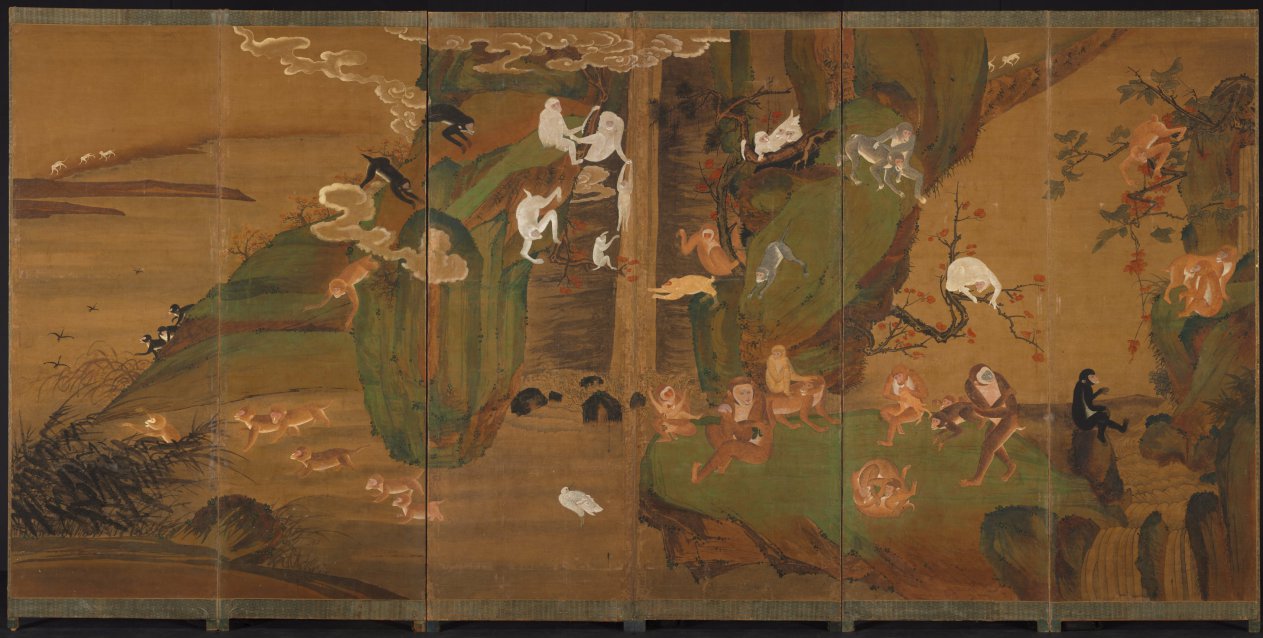
Gibbons in a Landscape (early 1900s) is in the Cleveland Museum of Art collection.
The work and its context
The museum's open-access catalogue describes the work:
In this folding screen, gibbons playfully interact with each other. In Korean paintings, gibbons were less frequently depicted than in their Chinese and Japanese counterparts. However, they became popular toward the end of the 1800s, possibly due to an influx of Chinese and Japanese decorative arts. Gibbons symbolize good fortune, but as paired with the red autumn foliage, specifically refer to professional success, such as passing the government examination and getting promoted to a higher position. The large ripe peach held by one gibbon bears another symbolic meaning: prosperity and longevity.
Object facts
- Title: Gibbons in a Landscape
- Date: early 1900s
- Culture: Korea, Joseon dynasty (1392–1910)
- Type: Painting
- Technique: Six-panel folding screen; ink and color on hemp
- Dimensions: Painting only: 104.8 x 393.7 cm (41 1/4 x 155 in.)
- Collection: ASIAN - Folding screen
- Department: Korean Art
- Accession number: 1996.256
A detail from the museum
Gibbons were often presented to the Joseon royal court as diplomatic gifts from the Japanese government.
Collection credit
Leonard C. Hanna Jr. Fund
Further reading listed by the museum
- Cleveland Museum of Art, “Rare Korean Screen Painting, Important Baroque Drawing, Sheeler Drawing Join the Museum Collection,” October 10, 1996, Cleveland Museum of Art Archives.
- Art of Korean Empire: The Emergence of Modern Art [대한제국의 미술-빛의 길을 꿈꾸다]. Seoul: Museum of Modern and Contemporary Art, 2018.
- Beyond Folding Screens [조선, 병풍의 나라]. Seoul: Amorepacific Museum of Art, 2018.
View the collection record
See the museum's photographs and full catalogue entry. Catalogue text is reproduced from the Cleveland Museum of Art's open-access data, with HTML formatting removed. This object and its supplied image are designated CC0.
Sources
More in Lifestyle
Keep reading