Gibbons Reaching for the Moon (1600s): Art, History and Details
Gibbons Reaching for the Moon at the Cleveland Museum of Art: 1600s, Hanging scroll; ink and light color on silk. Explore the work's context, creator attribution and collection history.
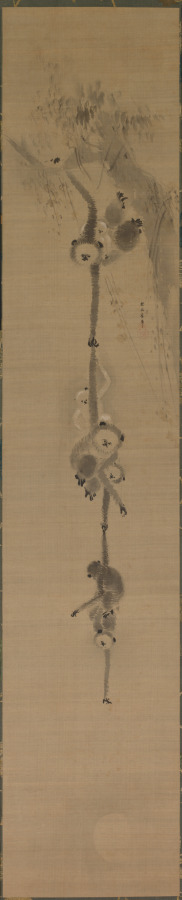
Gibbons Reaching for the Moon (1600s) is in the Cleveland Museum of Art collection. The museum's creator attribution is Kano Tan’yū (Japanese, 1602–1674).
The work and its context
The museum's open-access catalogue describes the work:
Long-armed gibbons form a chain to reach down from a tree, hoping to touch what they believe is the moon. In fact, the orb remaining beyond their grasp is the full moon’s reflection in the still surface of a pond or lake. The image is a common metaphor for the deluded mind in Buddhist thought. Gibbons do not live in Japan but were known to Japanese painters of the premodern era through paintings brought from China.
Object facts
- Title: Gibbons Reaching for the Moon
- Date: 1600s
- Creator attribution: Kano Tan’yū (Japanese, 1602–1674)
- Culture: Japan, Edo period (1615–1868)
- Type: Painting
- Technique: Hanging scroll; ink and light color on silk
- Dimensions: Painting: 170 x 33.9 cm (66 15/16 x 13 3/8 in.); Overall with knobs: 234 x 40.1 cm (92 1/8 x 15 13/16 in.)
- Collection: ASIAN - Hanging scroll
- Department: Japanese Art
- Accession number: 2015.478
Collection credit
Gift from the Collection of George Gund III
View the collection record
See the museum's photographs and full catalogue entry. Catalogue text is reproduced from the Cleveland Museum of Art's open-access data, with HTML formatting removed. This object and its supplied image are designated CC0.
Sources
More in Lifestyle
Keep reading