Goddess Holding a Lotus (c. 950): Art, History and Details
Goddess Holding a Lotus at the Cleveland Museum of Art: c. 950, bronze. Explore the work's context, creator attribution and collection history.
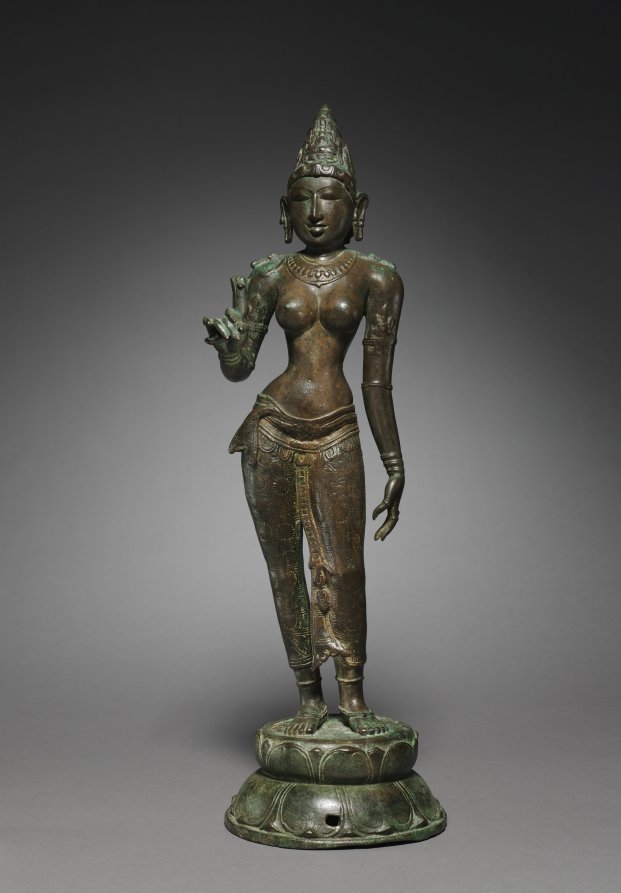
Goddess Holding a Lotus (c. 950) is in the Cleveland Museum of Art collection.
The work and its context
The museum's open-access catalogue describes the work:
Sculptors worked to create an ideal figure that would be worthy of holding the sacred presence of a goddess. They referenced a system of proportions and attributes, such as the lotus she holds, described in sacred Hindu texts.Solar medallions and floral vines referencing the sunlight and water necessary for life adorn her skirt. Her lotus pedestal indicates that she is divine. When brought out for public viewing and processions, the sculpture was draped with textiles and flowers. This sculpture may have been made in the workshop of the Chola queen Sembiyan Mahadevi, whose husband reigned from 941 to 957.
Object facts
- Title: Goddess Holding a Lotus
- Date: c. 950
- Culture: South India, Tamil Nadu, Chola period (800s–1200s)
- Type: Sculpture
- Technique: bronze
- Dimensions: Overall: 64.1 cm (25 1/4 in.)
- Collection: Indian Art
- Department: Indian and Southeast Asian Art
- Accession number: 1984.2
A detail from the museum
Her left arm hangs gracefully "like the trunk of an elephant."
Collection credit
Leonard C. Hanna Jr. Fund
Further reading listed by the museum
- Asia Society. Masterpieces of Asian Art in American Collections II; An Offering of Treasures Celebrating the Tenth Anniversary of Asia House Gallery. New York: Distributed by New York Graphic Society, 1970.
- Pal, Pratapaditya. The Sensuous Immortals: A Selection of Sculptures from the Pan-Asian Collection. Los Angeles: Los Angeles County Museum of Art, 1977.
- Turner, Evan H. “The Year in Review for 1984.” The Bulletin of the Cleveland Museum of Art, vol. 72, no. 2, 1985, pp. 163–207.
View the collection record
See the museum's photographs and full catalogue entry. Catalogue text is reproduced from the Cleveland Museum of Art's open-access data, with HTML formatting removed. This object and its supplied image are designated CC0.
Sources
More in Lifestyle
Keep reading