Grapevine (early 1800s): Art, History and Details
Grapevine at the Cleveland Museum of Art: early 1800s, eight-panel folding screen; ink on paper. Explore the work's context, creator attribution and collection history.
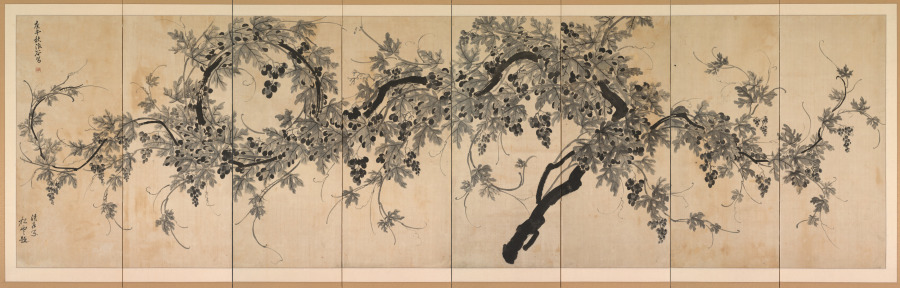
Grapevine (early 1800s) is in the Cleveland Museum of Art collection. The museum's creator attribution is Choe Seok-hwan (Korean, active first half of 19th century).
The work and its context
The museum's open-access catalogue describes the work:
July is the season of the ripening deep blue grapes, and also the month when the monsoon season begins in Korea. To the accompaniment of stormy summer wind, grape vines make a spectacular full circle across the surface of this eight-panel folding screen. The artist employed a variety of ink tones to create a sense of swift movement of grapevines amid turbulent storms. Since their first introduction to the Korean peninsula around the 7th century through the Silk Road, grapes were used as artistic motifs. Artists embellished the surface of mother-of-pearl lacquer boxes or blue-and-white porcelain, while scholar-poets composed poems about the luscious sweet sourness of green grapes. By the late 19th century, grapes became the icon of fertility: the fruit grows in large clusters of many individual grapes, evoking the image of a stable clan with many descendants.
Object facts
- Title: Grapevine
- Date: early 1800s
- Creator attribution: Choe Seok-hwan (Korean, active first half of 19th century)
- Culture: Korea, Joseon dynasty (1392–1910)
- Type: Painting
- Technique: eight-panel folding screen; ink on paper
- Dimensions: Image: 100.5 x 345 cm (39 9/16 x 135 13/16 in.)
- Collection: ASIAN - Folding screen
- Department: Korean Art
- Accession number: 2015.510
A detail from the museum
Grapes in premodern East Asia symbolize many children.
Collection credit
Gift from the Collection of George Gund III
Further reading listed by the museum
- Treasures from Korea: Arts and Culture of the Joseon Dynasty, 1392-1910. Philadelphia: Philadelphia Museum of Art, 2014.
- Beyond Folding Screens [조선, 병풍의 나라]. Seoul: Amorepacific Museum of Art, 2018.
View the collection record
See the museum's photographs and full catalogue entry. Catalogue text is reproduced from the Cleveland Museum of Art's open-access data, with HTML formatting removed. This object and its supplied image are designated CC0.
Sources
More in Lifestyle
Keep reading