Gravestone in the Form of a Lekythos (300s BCE): Art, History and Details
Gravestone in the Form of a Lekythos at the Cleveland Museum of Art: 300s BCE, marble. Explore the work's context, creator attribution and collection history.
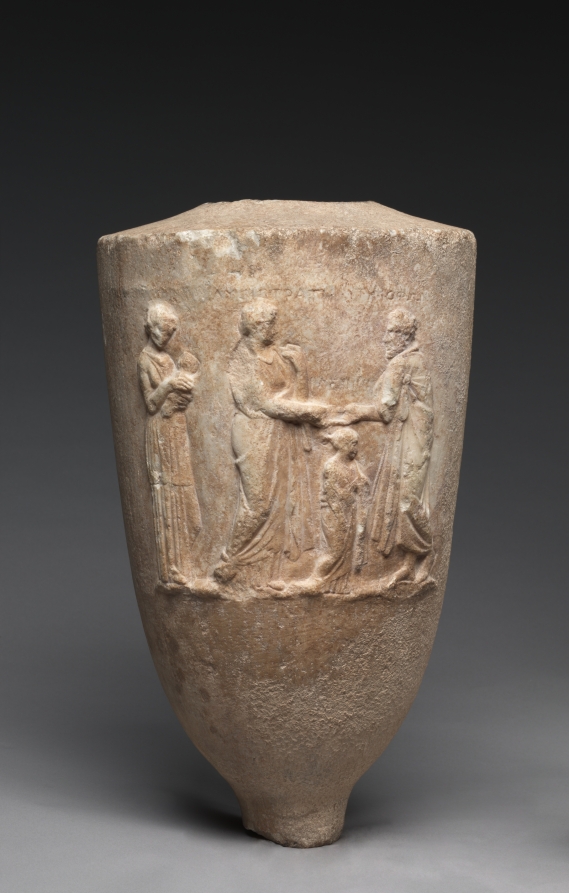
Gravestone in the Form of a Lekythos (300s BCE) is in the Cleveland Museum of Art collection.
The work and its context
The museum's open-access catalogue describes the work:
This grave marker takes the form of a lekythos, a type of vase (usually ceramic) commonly left as a grave offering in ancient Athens. Now fragmentary, it once had a foot below and a thin neck and vertical handle above. Five sculpted figures adorn its front. At left, an unnamed woman holds an infant. To their right, a woman, Lysistrate, clasps hands with a bearded man, Timophon. Between them stands a young girl, likely Kleippe, although her name is partially lost. The scene may commemorate Lysistrate’s death in childbirth, mourned by her husband and older child. Her newborn child apparently survived.
Object facts
- Title: Gravestone in the Form of a Lekythos
- Date: 300s BCE
- Culture: Greece, Athens
- Type: Sculpture
- Technique: marble
- Dimensions: Overall: 53.7 cm (21 1/8 in.)
- Collection: GR - Greek
- Department: Greek and Roman Art
- Accession number: 1925.1342
A detail from the museum
Inscriptions identify three of the four standing figures sculpted in relief.
Collection credit
Gift of J. H. Wade
Further reading listed by the museum
- The Brummer Gallery Records. Cloisters (Museum), n.d.
- Howard, Rossiter "Recent Greek Accessions." The Bulletin of the Cleveland Museum of Art 13, no. 3 (March 1926)
- Art News (May 15, 1926)
View the collection record
See the museum's photographs and full catalogue entry. Catalogue text is reproduced from the Cleveland Museum of Art's open-access data, with HTML formatting removed. This object and its supplied image are designated CC0.
Sources
More in Lifestyle
Keep reading