Green Parrot (c. 1820): Art, History and Details
Green Parrot at the Cleveland Museum of Art: c. 1820, Gum tempera on paper. Explore the work's context, creator attribution and collection history.
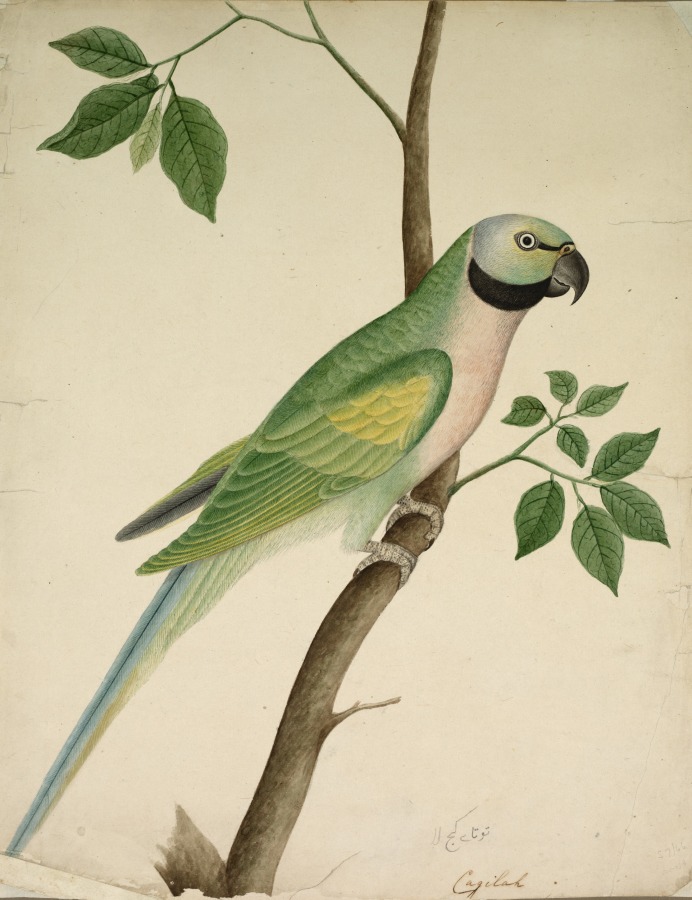
Green Parrot (c. 1820) is in the Cleveland Museum of Art collection.
The work and its context
The museum's open-access catalogue describes the work:
Made by an Indian artist for a British civil servant working in Calcutta (now Kolkata), this bird is portrayed with precision and brilliant color. It appears to be of the same type as Tuti, the protagonist of the early Mughal Tuti-nama (Tales of a Parrot) manuscript. This example, however, has a black beak, indicating she is female, while the male Tuti has a red beak. Though loosely translated as “parrot,” Tuti is technically a Lord Derby’s parakeet. Because of its ability to talk, the parrot often appears in Indo-Iranian tales as a messenger of moral wisdom.
Object facts
- Title: Green Parrot
- Date: c. 1820
- Culture: India, East India Company School
- Type: Painting
- Technique: Gum tempera on paper
- Dimensions: Overall: 38.5 x 28.6 cm (15 3/16 x 11 1/4 in.)
- Collection: Indian Art
- Department: Indian and Southeast Asian Art
- Accession number: 1972.285
A detail from the museum
This painting was owned by a founding partner of Cleveland law firm Hahn Loeser & Parks.
Collection credit
Bequest of Edgar A. Hahn
View the collection record
See the museum's photographs and full catalogue entry. Catalogue text is reproduced from the Cleveland Museum of Art's open-access data, with HTML formatting removed. This object and its supplied image are designated CC0.
Sources
More in Lifestyle
Keep reading