Gusu Beauty–Mother and Son in a Summer Pavilion (1736–95): Art, History and Details
Gusu Beauty–Mother and Son in a Summer Pavilion at the Cleveland Museum of Art: 1736–95, Polychrome woodblock print; ink and color on paper. Explore the work's context, creator attribution and collection history.
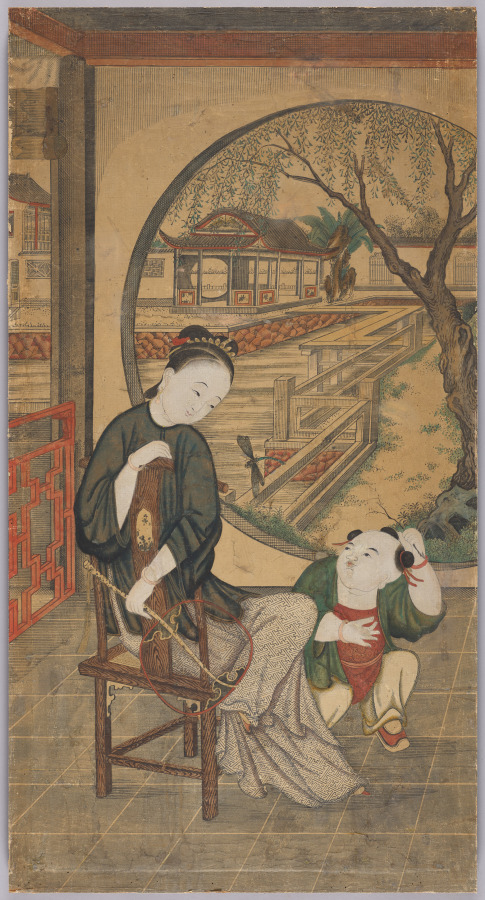
Gusu Beauty–Mother and Son in a Summer Pavilion (1736–95) is in the Cleveland Museum of Art collection.
The work and its context
The museum's open-access catalogue describes the work:
In the 1600s, printing flourished in such Jiangnan cities as Nanjing, Suzhou, Hangzhou, and Huizhou, evolving from privately enjoyed illustrated books printed in color to more commercialized single-sheet color prints that were hung on walls and became part of the rich urban visual culture.
Object facts
- Title: Gusu Beauty–Mother and Son in a Summer Pavilion
- Date: 1736–95
- Culture: Southeast China, Suzhou Qing dynasty (1644–1911), Qianlong period (1736–95)
- Type: Print
- Technique: Polychrome woodblock print; ink and color on paper
- Dimensions: Print only: 104.2 x 54.5 cm (41 x 21 7/16 in.); Overall: 112.9 x 62.9 cm (44 7/16 x 24 3/4 in.)
- Collection: China - Qing Dynasty
- Department: Chinese Art
- Accession number: 2025.47
A detail from the museum
Woodblock printing in color reached a height in China in the 1600s to 1700s. The prints were executed by means of sets of separate blocks, each carved to print a different color.
Collection credit
Purchase from the J. H. Wade Fund
Further reading listed by the museum
- von Spee, Clarissa. “Print Revolutions: The Art of Chinese Printmaking.” Cleveland Art: Cleveland Museum of Art Members Magazine 66, no. 3 (2026): 10–11.
View the collection record
See the museum's photographs and full catalogue entry. Catalogue text is reproduced from the Cleveland Museum of Art's open-access data, with HTML formatting removed. This object and its supplied image are designated CC0.
Sources
More in Lifestyle
Keep reading