Half of a "Sampot" (Skirt Cloth) (1800s–early 1900s): Art, History and Details
Half of a "Sampot" (Skirt Cloth) at the Cleveland Museum of Art: 1800s–early 1900s, tabby weave, weft ikat; silk. Explore the work's context, creator attribution and collection history.
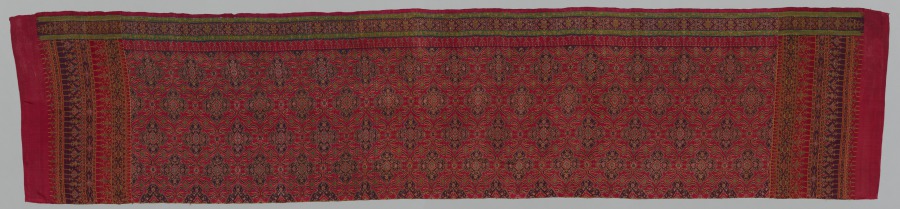
Half of a "Sampot" (Skirt Cloth) (1800s–early 1900s) is in the Cleveland Museum of Art collection.
The work and its context
The museum's open-access catalogue describes the work:
Ikat-dyed silks from Southeast Asia are weft ikats. Both the technique and the use of silk originated in India and spread to those parts of Southeast Asia that were accessible to international trade. There, it gradually replaced the earlier technique of warp ikat using cotton. The antiquity of this technique in Cambodia is indicated by weft-ikat designs that are preserved on sculptures of the Ankor period (9th-13th centuries). The diagonal lattice pattern in the central field of this textile was common throughout Southeast Asia. Because the textile was inteded to be a skirt cloth, there is little figural representation in its design.
Object facts
- Title: Half of a "Sampot" (Skirt Cloth)
- Date: 1800s–early 1900s
- Culture: Cambodia, 19th - early 20th century
- Type: Textile
- Technique: tabby weave, weft ikat; silk
- Dimensions: Overall: 76.2 x 345.3 cm (30 x 135 15/16 in.)
- Collection: Textiles
- Department: Textiles
- Accession number: 1925.120
Collection credit
Purchase from the J. H. Wade Fund
View the collection record
See the museum's photographs and full catalogue entry. Catalogue text is reproduced from the Cleveland Museum of Art's open-access data, with HTML formatting removed. This object and its supplied image are designated CC0.
Sources
More in Lifestyle
Keep reading