Haniwa Horse (400s–500s CE): Art, History and Details
Haniwa Horse at the Cleveland Museum of Art: 400s–500s CE, earthenware with traces of pigment. Explore the work's context, creator attribution and collection history.
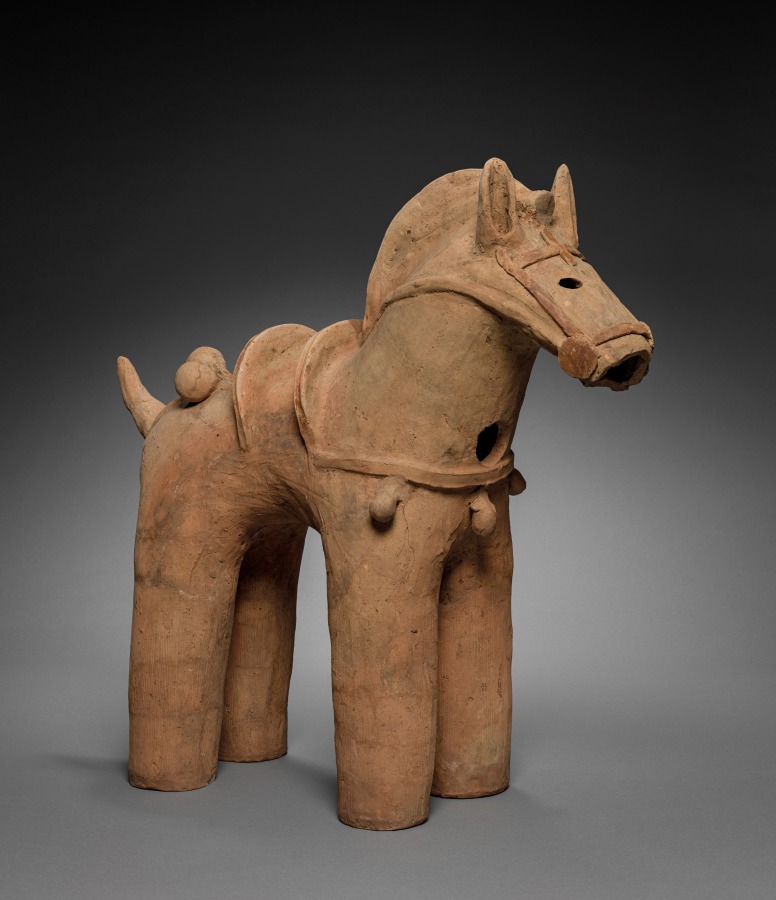
Haniwa Horse (400s–500s CE) is in the Cleveland Museum of Art collection.
The work and its context
The museum's open-access catalogue describes the work:
This horse’s tack, with its round bells, resembles saddlery in fashion in Korea during the 400s–500s CE. Concurrent with mass migration from the Korean Peninsula, tombs covered with large earthen mounds similar to those on the Asian continent began to appear in Japan around the year 300 CE. Called “old mounds” (kofun), their surfaces were covered with hollow clay cylinders (haniwa). Sculptures of animals, buildings, and finally human figures followed, developing over the ensuing three centuries.
Object facts
- Title: Haniwa Horse
- Date: 400s–500s CE
- Culture: Japan, Kofun period (300–710 CE)
- Type: Sculpture
- Technique: earthenware with traces of pigment
- Dimensions: Overall: 59.7 x 66 cm (23 1/2 x 26 in.)
- Collection: Japanese Art
- Department: Japanese Art
- Accession number: 1957.27
Collection credit
The Norweb Collection
Further reading listed by the museum
- The Cleveland Museum of Art. The Cleveland Museum of Art Handbook. Cleveland, OH: The Cleveland Museum of Art, 1958.
- "Recent Accessions Briefly Noted." The Bulletin of the Cleveland Museum of Art 46, no. 4 (April 1959): 60–61.
- Lee, Sherman E. "Contrasts in Chinese and Japanese Art." Journal of Aesthetics and Art Criticism 21, no. 1 (Fall 1962): 3–12.
View the collection record
See the museum's photographs and full catalogue entry. Catalogue text is reproduced from the Cleveland Museum of Art's open-access data, with HTML formatting removed. This object and its supplied image are designated CC0.
Sources
More in Lifestyle
Keep reading