Happy Forest, from Water Margin (late 1700s): Art, History and Details
Happy Forest, from Water Margin at the Cleveland Museum of Art: late 1700s, hanging scroll; ink and color on paper. Explore the work's context, creator attribution and collection history.
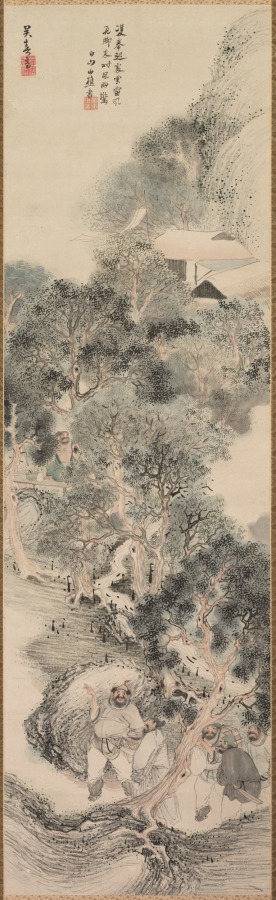
Happy Forest, from Water Margin (late 1700s) is in the Cleveland Museum of Art collection. The museum's creator attribution is Matsumura Goshun (Japanese, 1752–1811); Amenomori Shōteki (Japanese, 1731–1786).
The work and its context
The museum's open-access catalogue describes the work:
The Chinese literary classic Water Margin is set in the 1120s and tells the story of 108 outlaws who first rebel against the government and then join forces with it. This painting depicts an episode in which hero Wu Song reclaims the tavern Happy Forest for its rightful owner, the prison warden’s son, Shi En. To prepare for the fight, Wu Song drinks a lot of wine. The painting was inscribed with a quote in which an ally describes Wu Song’s fighting style. It reads as follows: Where his twin fists rise, clouds and thunder roar, When his flying kick comes, wind and rain tremble.
Object facts
- Title: Happy Forest, from Water Margin
- Date: late 1700s
- Creator attribution: Matsumura Goshun (Japanese, 1752–1811); Amenomori Shōteki (Japanese, 1731–1786)
- Culture: Japan, Edo period (1615–1868)
- Type: Painting
- Technique: hanging scroll; ink and color on paper
- Dimensions: Image: 137.8 x 41.3 cm (54 1/4 x 16 1/4 in.); Overall: 209.6 x 62.3 cm (82 1/2 x 24 1/2 in.)
- Collection: ASIAN - Hanging scroll
- Department: Japanese Art
- Accession number: 1986.95
Collection credit
Mr. and Mrs. William H. Marlatt Fund
Further reading listed by the museum
- Turner, Evan H. “The Year in Review for 1986.” The Bulletin of the Cleveland Museum of Art 74, no. 2 (February 1987): 38–79.
- Cunningham, Michael R. Unfolding Beauty: Japanese Screens from the Cleveland Museum of Art. Cleveland, OH: Cleveland Museum of Art, 2001.
View the collection record
See the museum's photographs and full catalogue entry. Catalogue text is reproduced from the Cleveland Museum of Art's open-access data, with HTML formatting removed. This object and its supplied image are designated CC0.
Sources
More in Lifestyle
Keep reading