Happy New Year 1917 (1917): Art, History and Details
Happy New Year 1917 at the Cleveland Museum of Art: 1917, drypoint. Explore the work's context, creator attribution and collection history.
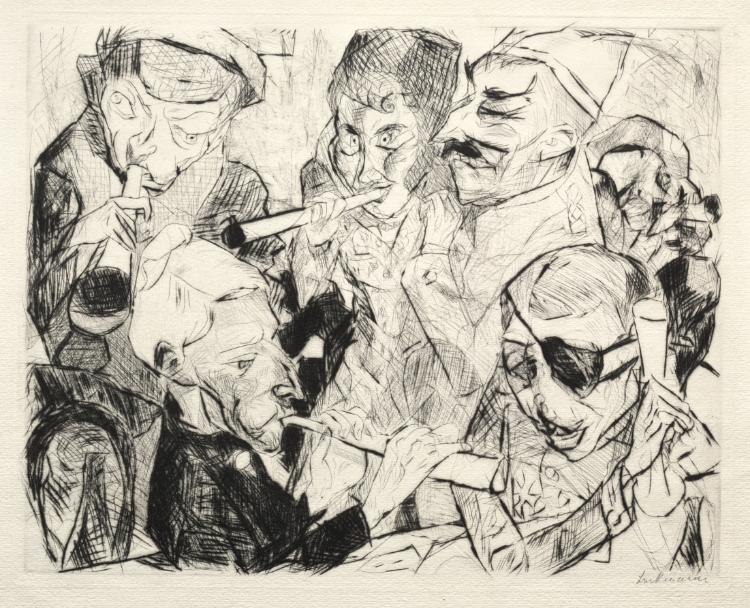
Happy New Year 1917 (1917) is in the Cleveland Museum of Art collection. The museum's creator attribution is Max Beckmann (German, 1884–1950).
The work and its context
The museum's open-access catalogue describes the work:
This closely packed image portrays a mix of people at a holiday party. A skeleton-like war veteran with a patched eye is just one of several inebriated patrons whose celebration of a new year, Beckmann implies, is pure folly. The artist often worked in drypoint, a method of directly scratching a plate to create an image that, when inked, retains a velvety burr around the lines. The technique allowed him to work spontaneously, similar to sketching with a pen on paper.
Object facts
- Title: Happy New Year 1917
- Date: 1917
- Creator attribution: Max Beckmann (German, 1884–1950)
- Culture: Germany, 20th century
- Type: Print
- Technique: drypoint
- Dimensions: Sheet: 29.8 x 37 cm (11 3/4 x 14 9/16 in.); Plate: 24.2 x 29.8 cm (9 1/2 x 11 3/4 in.)
- Collection: PR - Drypoint
- Department: Prints
- Accession number: 1975.53
Collection credit
Gift of The Print Club of Cleveland
Further reading listed by the museum
- Lee, Sherman E. “The Year in Review for 1975.” The Bulletin of the Cleveland Museum of Art 63, no. 2 (February 1976): 31–71.
View the collection record
See the museum's photographs and full catalogue entry. Catalogue text is reproduced from the Cleveland Museum of Art's open-access data, with HTML formatting removed. This object and its supplied image are designated CC0.
Sources
More in Lifestyle
Keep reading
Related stories