Head of a Woman (500–475 BCE): Art, History and Details
Head of a Woman at the Cleveland Museum of Art: 500–475 BCE, terracotta. Explore the work's context, creator attribution and collection history.
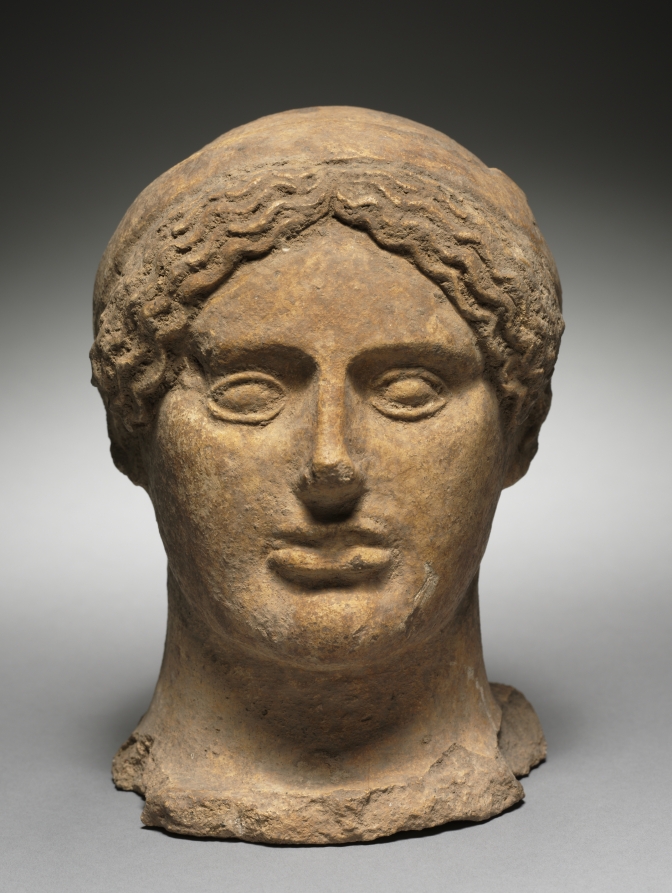
Head of a Woman (500–475 BCE) is in the Cleveland Museum of Art collection.
The work and its context
The museum's open-access catalogue describes the work:
Probably created for use as a votive dedication, or an offering to a deity, this mold-made female head tops a broad neck spreading into a flat base; no bust or body was intended. The wavy hair, parted in the center, drapes before the ears and beneath a simple headband, framing the face and emphasizing the frontal view. Although three-dimensional, the head is unworked on its back half.
Object facts
- Title: Head of a Woman
- Date: 500–475 BCE
- Culture: Etruscan
- Type: Sculpture
- Technique: terracotta
- Dimensions: Overall: 20.3 cm (8 in.)
- Collection: GR - Etruscan
- Department: Greek and Roman Art
- Accession number: 1921.414
A detail from the museum
This sculpture is an example of ancient mass production, as many identical heads could be made from one mold.
Collection credit
Charles W. Harkness Endowment Fund
Further reading listed by the museum
- Smithers, Stephen. "Images of Piety and Hope: Select Terracotta Votives from West-Central Italy," in Studia Varia from the J. Paul Getty Museum Vol 1 (Occasional Papers on Antiquities, vol. 8), pp. 13-32. Malibu, CA: J. Paul Getty Museum.
View the collection record
See the museum's photographs and full catalogue entry. Catalogue text is reproduced from the Cleveland Museum of Art's open-access data, with HTML formatting removed. This object and its supplied image are designated CC0.
Sources
More in Lifestyle
Keep reading