Head of Buddha (400s CE): Art, History and Details
Head of Buddha at the Cleveland Museum of Art: 400s CE, sandstone. Explore the work's context, creator attribution and collection history.
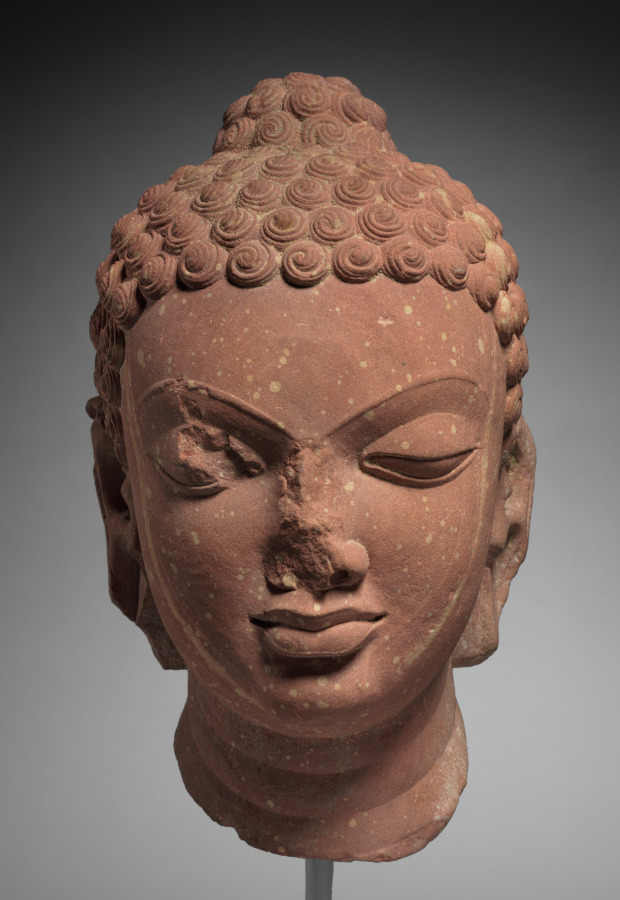
Head of Buddha (400s CE) is in the Cleveland Museum of Art collection.
The work and its context
The museum's open-access catalogue describes the work:
The brows arch with tension and alertness, though the lids are half closed. Short curls cover his head and cranial protuberance, which during this period came to be interpreted as a mark of one who has reached enlightenment, his state of awareness having surpassed the boundaries of an ordinary human being. Sculptors working during the time when kings of the Gupta dynasty (c. 319–550 CE) ruled northern India achieved a balance between fleshy volumes and idealized linear features. This balance led scholars to consider the Gupta period to be a “classical” age of Indian art.
Object facts
- Title: Head of Buddha
- Date: 400s CE
- Culture: Northern India, Uttar Pradesh, Mathura
- Type: Sculpture
- Technique: sandstone
- Dimensions: Overall: 30.6 x 16.6 cm (12 1/16 x 6 9/16 in.)
- Collection: Indian Art
- Department: Indian and Southeast Asian Art
- Accession number: 1963.504
Collection credit
John L. Severance Fund
Further reading listed by the museum
- Lee, Sherman E. “Year in Review for 1963.” The Bulletin of the Cleveland Museum of Art, vol. 50, no. 10, 1963, pp. 263–294.
- Kramer, Joellen. “A Buddha Head from Mathurā.” The Burlington Magazine (March 1965).
- The Cleveland Museum of Art. Handbook of the Cleveland Museum of Art/1966. Cleveland, OH: The Cleveland Museum of Art, 1966.
View the collection record
See the museum's photographs and full catalogue entry. Catalogue text is reproduced from the Cleveland Museum of Art's open-access data, with HTML formatting removed. This object and its supplied image are designated CC0.
Sources
More in Lifestyle
Keep reading