Head of Buddha (900s): Art, History and Details
Head of Buddha at the Cleveland Museum of Art: 900s, gilt bronze. Explore the work's context, creator attribution and collection history.
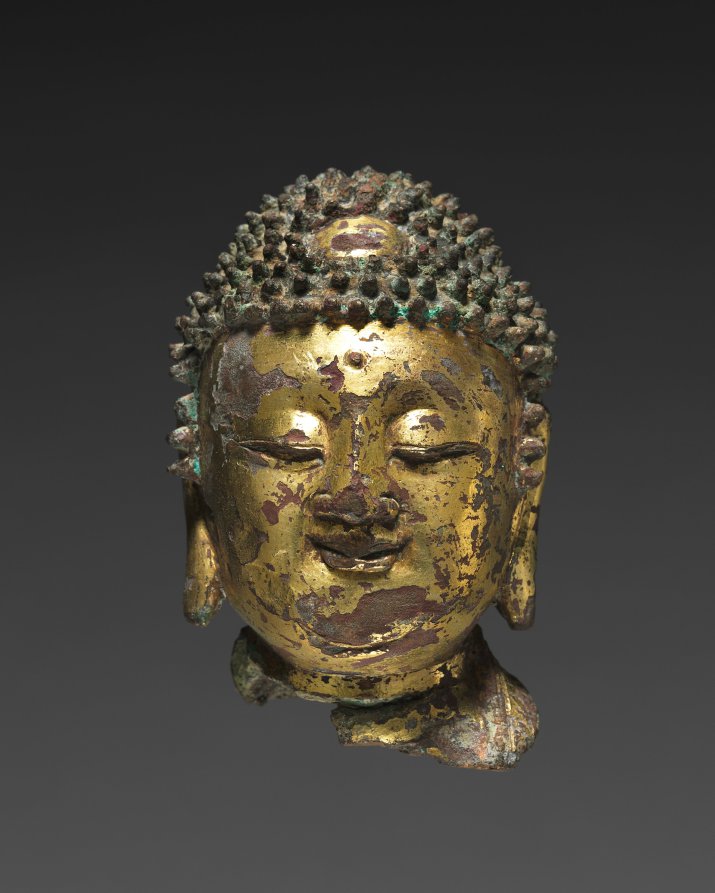
Head of Buddha (900s) is in the Cleveland Museum of Art collection.
The work and its context
The museum's open-access catalogue describes the work:
While large Buddhist statues were made mostly in stone during the Goryeo period (918–1392), small ones were made in gilt bronze, as a portable object of devotion by traveling Buddhist monks.
Object facts
- Title: Head of Buddha
- Date: 900s
- Culture: Korea, Goryeo dynasty (918–1392)
- Type: Sculpture
- Technique: gilt bronze
- Dimensions: Overall: 8.6 cm (3 3/8 in.)
- Collection: Korean Art
- Department: Korean Art
- Accession number: 1985.190
A detail from the museum
A gentle smile crossing the Buddha's face here is a sign of compassion.
Collection credit
Gift of Robert H. Ellsworth in honor of Sherman E. Lee
Further reading listed by the museum
- Turner, Evan H. “The Year in Review for 1985.” The Bulletin of the Cleveland Museum of Art, vol. 73, no. 2, 1986, pp. 26–71.
- Goryeo Dynasty: Korea's Age of Enlightenment, 918-1392. San Francisco: Asian Art Museum, 2003.
- Yim, Nam-su and Jeong Eun-woo. “Changes in Fashioning Small Gilt Bronze Buddhist Statues and their Techniques from the Late Goryeo to Early Joseon Periods [여말선초 소금동불의 유행과 제작기법의 변화]. Misul sahak (2010): 259–290.
View the collection record
See the museum's photographs and full catalogue entry. Catalogue text is reproduced from the Cleveland Museum of Art's open-access data, with HTML formatting removed. This object and its supplied image are designated CC0.
Sources
More in Lifestyle
Keep reading
Related stories