Head of Buddha (early 800s): Art, History and Details
Head of Buddha at the Cleveland Museum of Art: early 800s, volcanic stone. Explore the work's context, creator attribution and collection history.
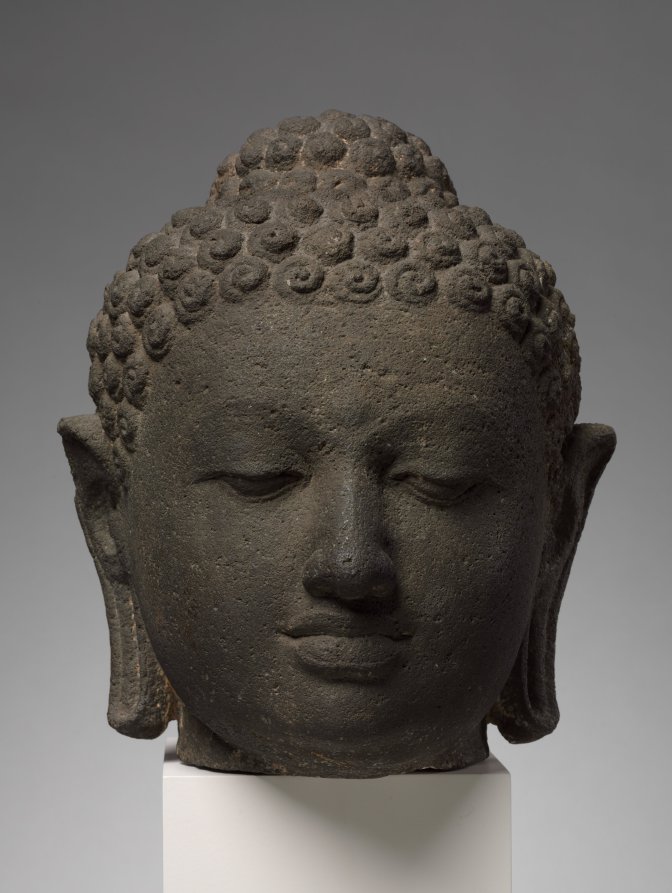
Head of Buddha (early 800s) is in the Cleveland Museum of Art collection.
The work and its context
The museum's open-access catalogue describes the work:
Serenity, tranquility, and compassion are expressively conveyed in the gently modeled, highly porous black stone of the volcanic island of Java. Borobudur, the massive, multitiered stone structure from which it came, still stands as one of the most impressive Buddhist monuments in the world. Concentric walkways with carved pilgrimage scenes lead up to vast terraces that originally had more than 500 life-size Buddha images, many of which still remain.
Object facts
- Title: Head of Buddha
- Date: early 800s
- Culture: Indonesia, Java, Borobudur, Sailendra Period, 9th Century
- Type: Sculpture
- Technique: volcanic stone
- Dimensions: Overall: 30.6 cm (12 1/16 in.)
- Collection: Javanese Art
- Department: Indian and Southeast Asian Art
- Accession number: 1942.1087
Collection credit
Purchase from the J. H. Wade Fund
Further reading listed by the museum
- Hollis, Howard. "A Javanese Head." The Bulletin of the Cleveland Museum of Art 30, no. 3 (March 1943): 28.
- The Cleveland Museum of Art. The Cleveland Museum of Art Handbook. Cleveland, OH: The Cleveland Museum of Art, 1958.
- The Cleveland Museum of Art. Handbook of the Cleveland Museum of Art/1966. Cleveland, OH: The Cleveland Museum of Art, 1966.
View the collection record
See the museum's photographs and full catalogue entry. Catalogue text is reproduced from the Cleveland Museum of Art's open-access data, with HTML formatting removed. This object and its supplied image are designated CC0.
Sources
More in Lifestyle
Keep reading
Related stories