Head of Vishnu (300s CE): Art, History and Details
Head of Vishnu at the Cleveland Museum of Art: 300s CE, sandstone. Explore the work's context, creator attribution and collection history.
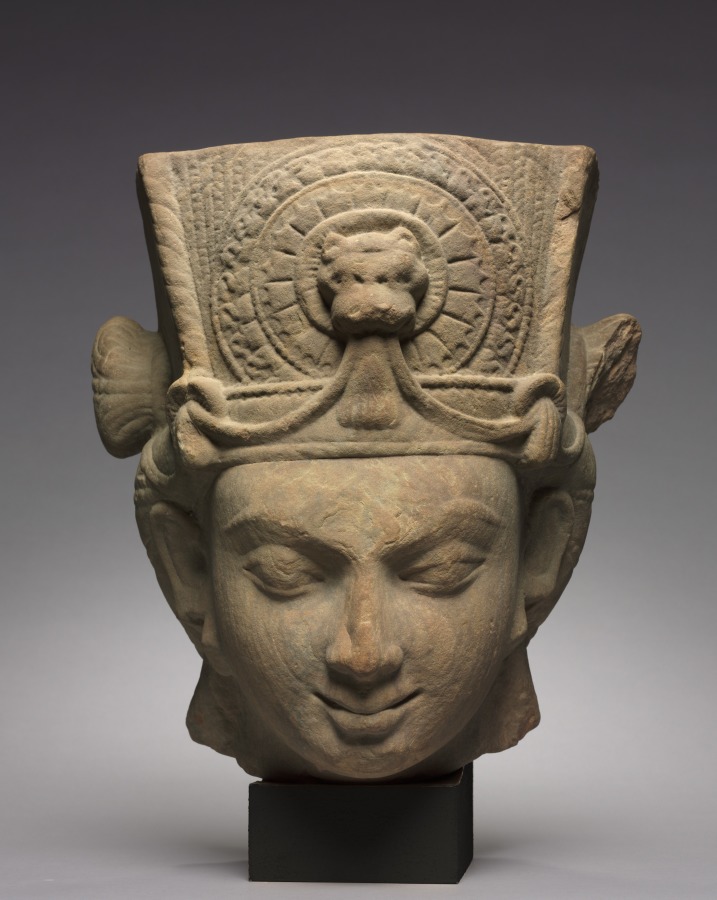
Head of Vishnu (300s CE) is in the Cleveland Museum of Art collection.
The work and its context
The museum's open-access catalogue describes the work:
When complete, this iconic image of the Hindu god Vishnu would have been impressive in scale, approximately life-size. During the Gupta period (c. 319–550 CE), images of Vishnu included a lion head in the center of the crown. The lion communicated royal authority, solar radiance, and the concept of glory. These attributes characterize the power and personality of this deity who ensures the preservation of his creation.
Object facts
- Title: Head of Vishnu
- Date: 300s CE
- Culture: Central India, Madhya Pradesh, Vidisha
- Type: Sculpture
- Technique: sandstone
- Dimensions: Overall: 40.6 x 38.1 cm (16 x 15 in.)
- Collection: Indian Art
- Department: Indian and Southeast Asian Art
- Accession number: 1969.57
Collection credit
John L. Severance Fund
Further reading listed by the museum
- Lee, Sherman E. "The Year in Review for 1969." The Bulletin of the Cleveland Museum of Art 57, no. 1 (January 1970): 2-50.
- "Art of Asia Recently Acquired by American Museums, 1969." Archives of Asian Art 24 (1970): 86-117.
- Harle, J. C. Gupta Sculpture: Indian Sculpture of the Fourth to the Sixth Centuries A.D. Oxford [England]: Clarendon Press, 1974.
View the collection record
See the museum's photographs and full catalogue entry. Catalogue text is reproduced from the Cleveland Museum of Art's open-access data, with HTML formatting removed. This object and its supplied image are designated CC0.
Sources
More in Lifestyle
Keep reading