Head of Vishnu (400s CE): Art, History and Details
Head of Vishnu at the Cleveland Museum of Art: 400s CE, sandstone. Explore the work's context, creator attribution and collection history.
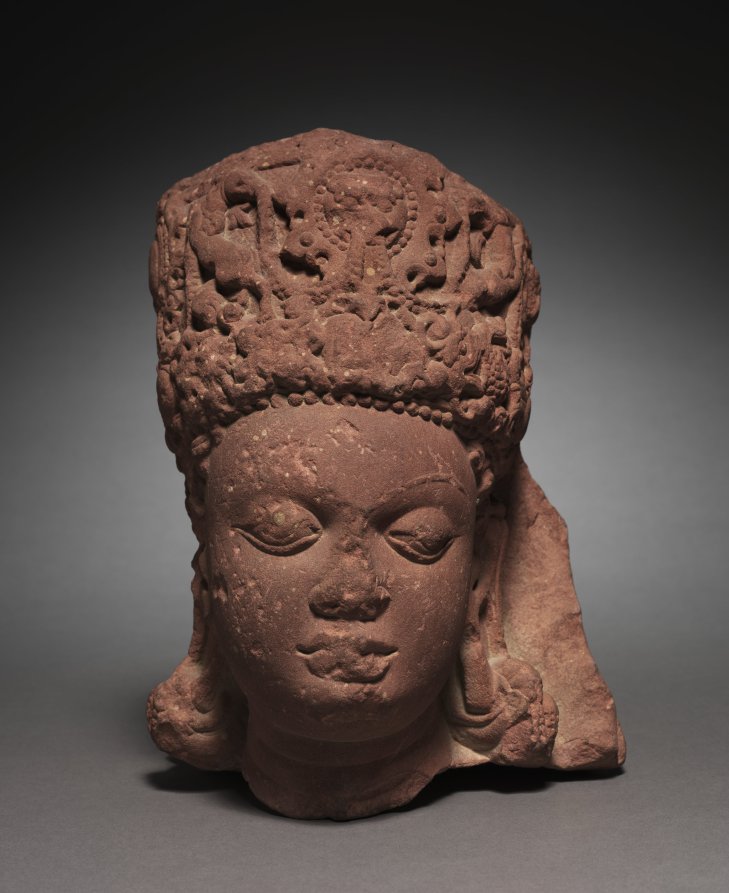
Head of Vishnu (400s CE) is in the Cleveland Museum of Art collection.
The work and its context
The museum's open-access catalogue describes the work:
During this period in India, the Hindu god Vishnu wears a distinctive squarish crown with a central medallion featuring a lion head. With strings of pearls issuing from his mouth, the imagery conveys the idea of radiance and glory. Devotees recognized Vishnu as having solar and royal attributes. His coiled ringlets of hair and heavy earrings also indicate that he was meant to have the appearance of a royal warrior.
Object facts
- Title: Head of Vishnu
- Date: 400s CE
- Culture: Northern India, Uttar Pradesh, Mathura
- Type: Sculpture
- Technique: sandstone
- Dimensions: Overall: 28 cm (11 in.)
- Collection: Indian Art
- Department: Indian and Southeast Asian Art
- Accession number: 1942.498
Collection credit
Edward L. Whittemore Fund
Further reading listed by the museum
- Coomaraswamy, Ananda K. History of Indian and Indonesian Art. New York: E Weyhe, 1927.
- Exposition de sculptures et bronzes anciens de l'Inde, 14 juin au 31 juillet 1935. Paris: C.T. Loo, 1935.
- Pope, John. An Exhibition of the Sculpture of Greater India, A Fully Illustrated Catalogue. New York: C.T. Loo & Co, 1942.
View the collection record
See the museum's photographs and full catalogue entry. Catalogue text is reproduced from the Cleveland Museum of Art's open-access data, with HTML formatting removed. This object and its supplied image are designated CC0.
Sources
More in Lifestyle
Keep reading
Related stories