Hercules and the Hydra (late 1500s-early 1600s): Art, History and Details
Hercules and the Hydra at the Cleveland Museum of Art: late 1500s-early 1600s, bronze. Explore the work's context, creator attribution and collection history.
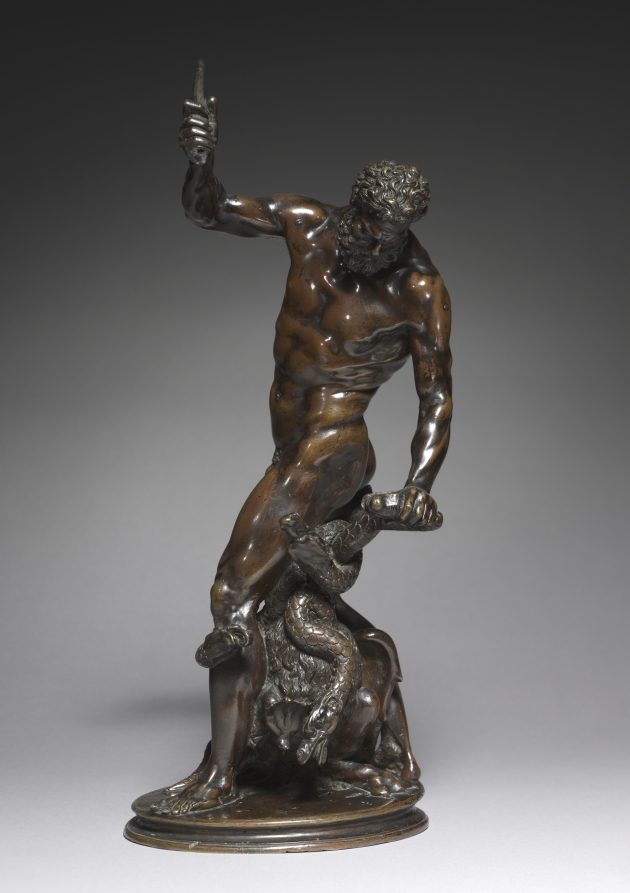
Hercules and the Hydra (late 1500s-early 1600s) is in the Cleveland Museum of Art collection.
The work and its context
The museum's open-access catalogue describes the work:
Hercules slayed the Lernean Hydra as the second of the ancient hero’s twelve labors. When one of the nine snake-like heads was destroyed, two grew back. Hercules cauterized each stump, allowing him eventually to kill the monster. The object he holds may have been a club, sword, sickle, or torch. The sinuous, scaly Hydra and the defined musculature presented challenging opportunities for sculptors working in bronze. The raw, tumultuous energy and twisting form-associated with artists of the late 1500s-contrasts to Jacopo Sansovino’s earlier Virgin and Child (1951.316).
Object facts
- Title: Hercules and the Hydra
- Date: late 1500s-early 1600s
- Culture: Northern Europe, late 16th-early 17th century
- Type: Sculpture
- Technique: bronze
- Dimensions: Overall: 47.5 x 18 x 18 cm (18 11/16 x 7 1/16 x 7 1/16 in.)
- Collection: Sculpture
- Department: European Painting and Sculpture
- Accession number: 1973.167
Collection credit
Purchase from the J. H. Wade Fund
Further reading listed by the museum
- “The Year in Review for 1973.” The Bulletin of the Cleveland Museum of Art 61, no. 2 (February 1974): 31–78.
- The Cleveland Museum of Art. Handbook of the Cleveland Museum of Art/1978. Cleveland, OH: The Cleveland Museum of Art, 1978. c
View the collection record
See the museum's photographs and full catalogue entry. Catalogue text is reproduced from the Cleveland Museum of Art's open-access data, with HTML formatting removed. This object and its supplied image are designated CC0.
Sources
More in Lifestyle
Keep reading