Heron-Shaped Figure Vase (Oil Vessel) (c. 580 BCE): Art, History and Details
Heron-Shaped Figure Vase (Oil Vessel) at the Cleveland Museum of Art: c. 580 BCE, ceramic. Explore the work's context, creator attribution and collection history.
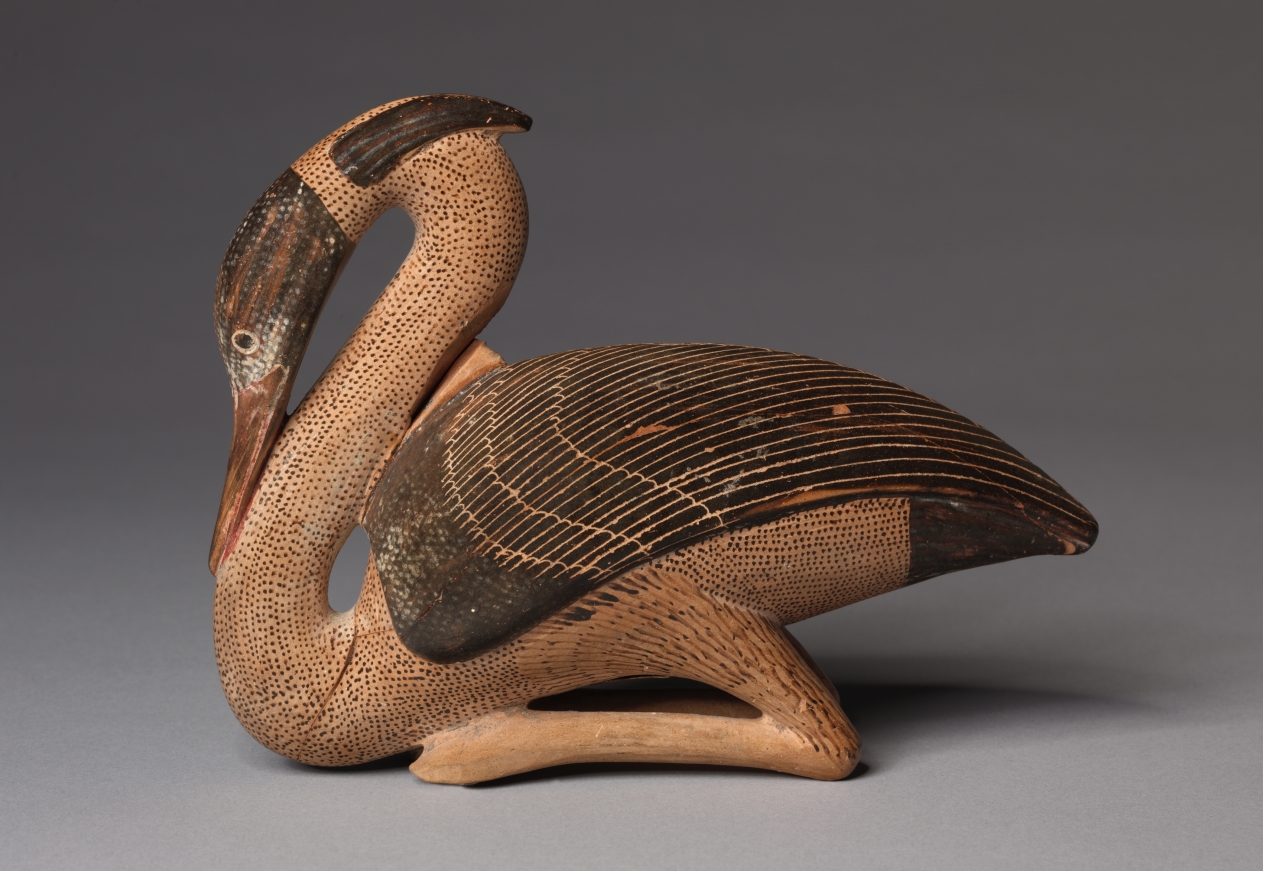
Heron-Shaped Figure Vase (Oil Vessel) (c. 580 BCE) is in the Cleveland Museum of Art collection. The museum's creator attribution is Robertson's Group.
The work and its context
The museum's open-access catalogue describes the work:
In the 6th century BC, a particular type of vessel for scented oil was produced in Corinth, Rhodes, and along the western coast of Asia Minor. Primarily animal forms, they are made of unglazed fired clay with painted decoration. This example in the form of a heron was crafted by a Milesian potter. The bird rests with its delicately curving and counter-curving neck nearly touching the ground; the feathers are defined by incision and painted black slip.
Object facts
- Title: Heron-Shaped Figure Vase (Oil Vessel)
- Date: c. 580 BCE
- Creator attribution: Robertson's Group
- Culture: East Greek, probably Milesian
- Type: Ceramic
- Technique: ceramic
- Dimensions: Overall: 13 x 5.8 cm (5 1/8 x 2 5/16 in.)
- Collection: GR - Greek
- Department: Greek and Roman Art
- Accession number: 1988.65
A detail from the museum
An aryballos is a vessel that contained scented oils, this one in the shape of a heron.
Collection credit
John L. Severance Fund
Further reading listed by the museum
- Beazley Archive. n.d. Beazley Archive Pottery Database. Oxford: Beazley Archive.
- "The Year in Review for 1988." The Bulletin of the Cleveland Museum of Art 76, no. 2 (1989)
- Biers, William R. "A Heron in Cleveland." The Bulletin of the Cleveland Museum of Art 76, no. 8 (1989).
View the collection record
See the museum's photographs and full catalogue entry. Catalogue text is reproduced from the Cleveland Museum of Art's open-access data, with HTML formatting removed. This object and its supplied image are designated CC0.
Sources
More in Lifestyle
Keep reading
Related stories