Hookah Base (c. 1750): Art, History and Details
Hookah Base at the Cleveland Museum of Art: c. 1750, gold on blue glass. Explore the work's context, creator attribution and collection history.
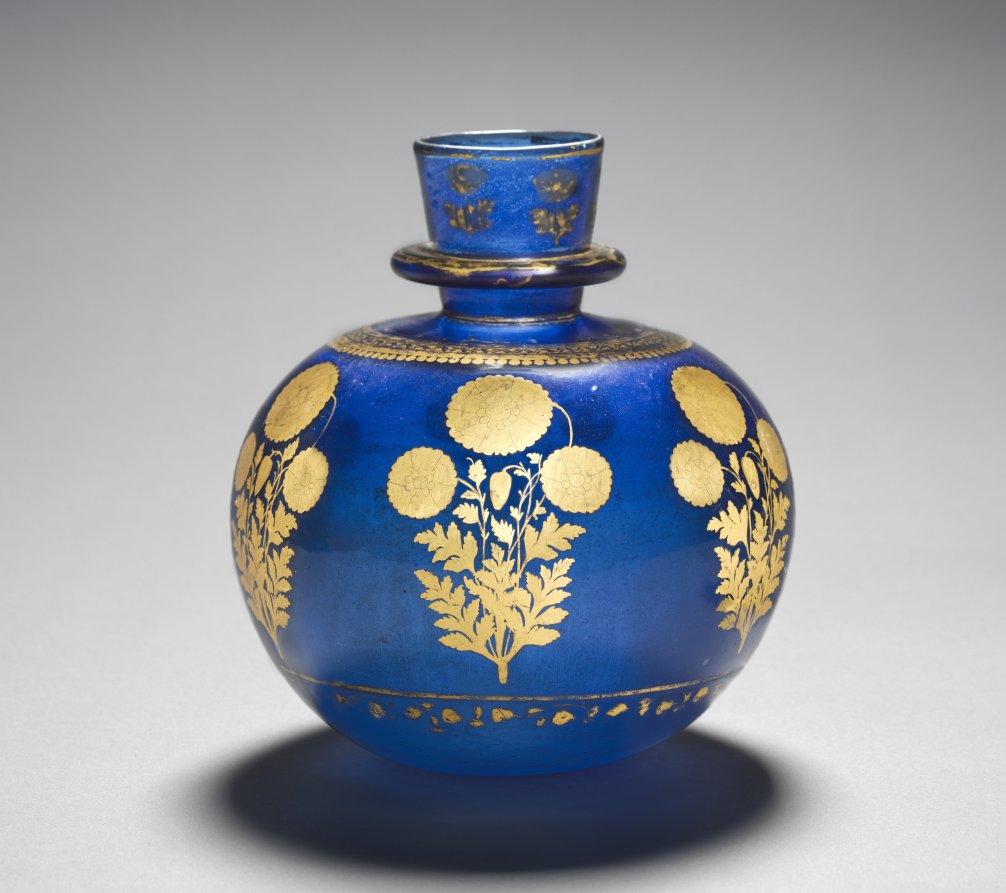
Hookah Base (c. 1750) is in the Cleveland Museum of Art collection.
The work and its context
The museum's open-access catalogue describes the work:
Smoking tobacco was introduced to the Mughal court from Iran in the very early 1600s and soon became popular. This base formed part of a hookah, or water pipe, which consisted of a base that held water—sometimes perfumed with herbs or fresh fruit—a detachable bowl to hold tobacco, and a long tube. Early hookahs used existing vessels for bases, including coconut shells. By the late 1600s or early 1700s, richly decorated pieces like this were produced. The striking gold poppies on a cobalt blue background might indicate that opium was used in the hookah.
Object facts
- Title: Hookah Base
- Date: c. 1750
- Culture: Mughal India, possibly Lucknow
- Type: Glass
- Technique: gold on blue glass
- Dimensions: Overall: 19.8 cm (7 13/16 in.)
- Collection: Indian Art
- Department: Indian and Southeast Asian Art
- Accession number: 1961.44
A detail from the museum
The neckpiece was made separately and attached to the blown glass bowl.
Collection credit
Cornelia Blakemore Warner Fund
Further reading listed by the museum
- Marcus, Margaret F. “A Gilded Blue Glass Vase: From Mughal India.” The Bulletin of the Cleveland Museum of Art 49, no. 10 (December 1962): 243–247. Published as: Gilded Blue Glass Vase
- Welch, Stuart Cary. The Art of Mughal India: Painting & Precious Objects. New York: Distributed by H.N. Abrams, 1963.
- Dikshit, Moreshwar Gangadhar. History of Indian Glass. [Bombay]: University of Bombay, 1969.
View the collection record
See the museum's photographs and full catalogue entry. Catalogue text is reproduced from the Cleveland Museum of Art's open-access data, with HTML formatting removed. This object and its supplied image are designated CC0.
Sources
More in Lifestyle
Keep reading