Hookah Bowl (1700s): Art, History and Details
Hookah Bowl at the Cleveland Museum of Art: 1700s, glass. Explore the work's context, creator attribution and collection history.
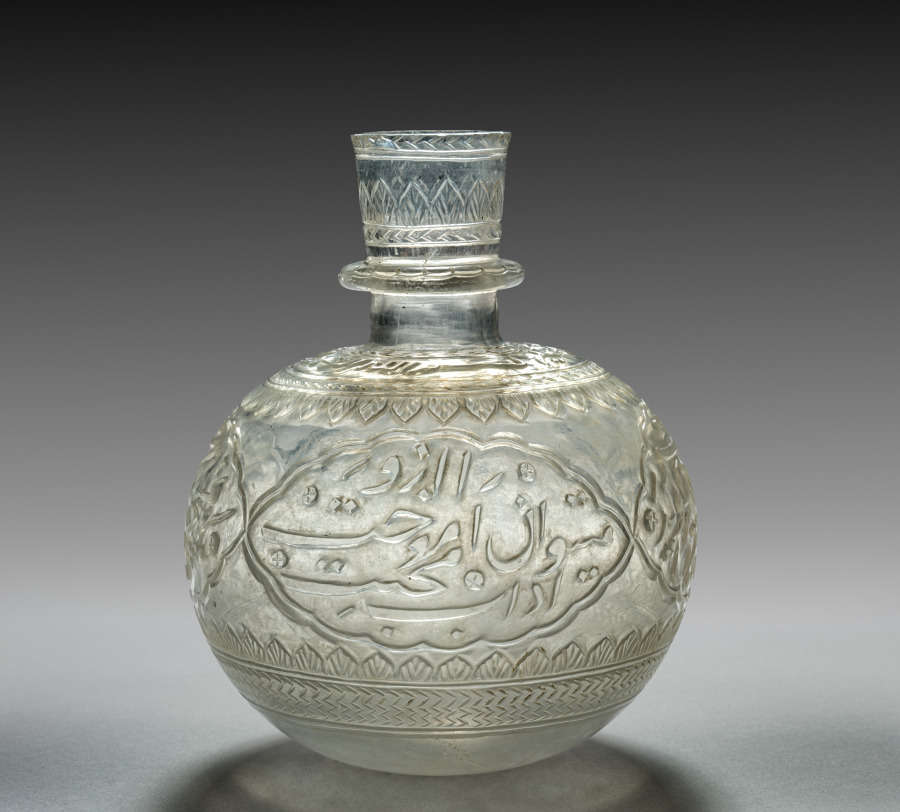
Hookah Bowl (1700s) is in the Cleveland Museum of Art collection.
The work and its context
The museum's open-access catalogue describes the work:
The inscription around the body of the base speaks to the use of the hookah in the decadent life of the Mughal court. The hookah is commended for being a proper, refined servant who will not “respond unless drawn upon” or, produce water bubbles when smoke is drawn through the hose. Undoubtedly the witty, poetic allusions would have been appreciated at banquets and other courtly gatherings. The use of wheel-cut glass for this hookah base may have been influenced by English glass and lead crystal that was exported to India
Object facts
- Title: Hookah Bowl
- Date: 1700s
- Culture: India, Mughal
- Type: Glass
- Technique: glass
- Dimensions: Overall: 17 cm (6 11/16 in.)
- Collection: Indian Art
- Department: Indian and Southeast Asian Art
- Accession number: 1969.287
A detail from the museum
Around the top of this hookah bowl are incised the opening two lines from the Khamsa (Quintet) of the celebrated Persian poet Nizami (1141–1209).
Collection credit
The Norweb Collection
Further reading listed by the museum
- Carboni, Stefano, and David Whitehouse. Glass of the Sultans. New York: Metropolitan Museum of Art, 2001.
- Desjardins, Tara. Mughal Glass: A History of Glassmaking in India. New Delhi: Roli Books, 2024.
View the collection record
See the museum's photographs and full catalogue entry. Catalogue text is reproduced from the Cleveland Museum of Art's open-access data, with HTML formatting removed. This object and its supplied image are designated CC0.
Sources
More in Lifestyle
Keep reading