Horse Stable (early 1500s): Art, History and Details
Horse Stable at the Cleveland Museum of Art: early 1500s, One of a pair of six-panel folding screens; ink, color, and gold on paper. Explore the work's context, creator attribution and collection history.
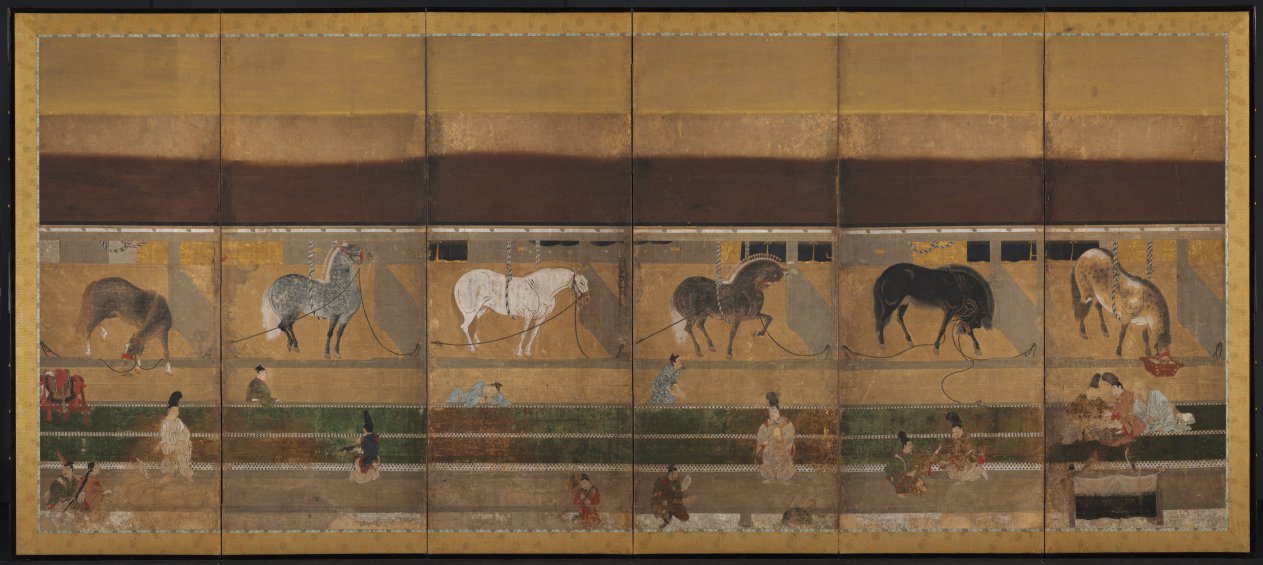
Horse Stable (early 1500s) is in the Cleveland Museum of Art collection.
The work and its context
The museum's open-access catalogue describes the work:
Prized horses in stables may be the main theme of the pair of screens of which this screen is a part, but a lot of action is happening on the veranda. Falconry is the focus of this screen, and a lively atmosphere develops in the interplay of the dynamic horses and the birds of prey.
Object facts
- Title: Horse Stable
- Date: early 1500s
- Culture: Japan, Muromachi period (1392–1573)
- Type: Painting
- Technique: One of a pair of six-panel folding screens; ink, color, and gold on paper
- Dimensions: Painting: 146.1 x 346.8 cm (57 1/2 x 136 9/16 in.); Mounted: 163.3 x 366 cm (64 5/16 x 144 1/8 in.)
- Collection: ASIAN - Folding screen
- Department: Japanese Art
- Accession number: 1934.373.2
A detail from the museum
This is the earliest surviving example of the "horse stable" theme in Japanese screens.
Collection credit
Edward L. Whittemore Fund
Further reading listed by the museum
- Hollis, Howard C. “A Pair of Japanese Screens.” The Bulletin of the Cleveland Museum of Art 24, no. 1 (January 1937): 5–8, 15.
- The Cleveland Museum of Art. The Cleveland Museum of Art Handbook. Cleveland, OH: The Cleveland Museum of Art, 1958.
- Lee, Sherman E. Japanese Decorative Style. [Cleveland]: Cleveland Museum of Art, 1961.
View the collection record
See the museum's photographs and full catalogue entry. Catalogue text is reproduced from the Cleveland Museum of Art's open-access data, with HTML formatting removed. This object and its supplied image are designated CC0.
Sources
More in Lifestyle
Keep reading