Ibis Eating a Lizard (100 BCE–100 CE): Art, History and Details
Ibis Eating a Lizard at the Cleveland Museum of Art: 100 BCE–100 CE, bronze, hollow cast. Explore the work's context, creator attribution and collection history.
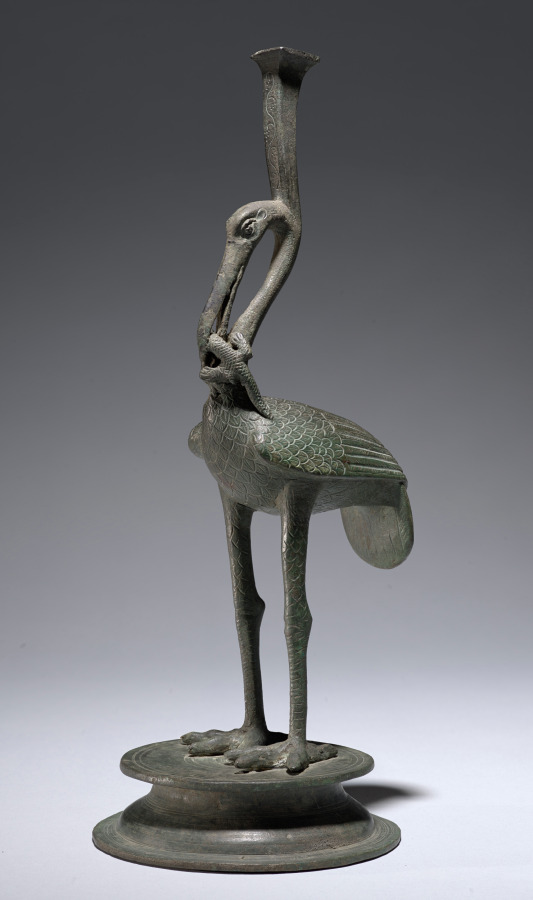
Ibis Eating a Lizard (100 BCE–100 CE) is in the Cleveland Museum of Art collection.
The work and its context
The museum's open-access catalogue describes the work:
The ibis is an Egyptian bird, shown here standing firmly on both legs with a lizard in its beak. The bird rests on a two-tiered circular base, and a vertical stem with incised decoration extends above the ibis’s head. While an Egyptian animal, the image of the ibis devouring a lizard became common only in the Roman world, depicted in wall paintings and seen on Barbotine ware, a type of pottery. This sculpture may be unique, however, in showing this motif in the round.
Object facts
- Title: Ibis Eating a Lizard
- Date: 100 BCE–100 CE
- Culture: Italy, Rome, Roman Empire
- Type: Sculpture
- Technique: bronze, hollow cast
- Dimensions: Overall: 37.5 cm (14 3/4 in.)
- Collection: GR - Roman
- Department: Greek and Roman Art
- Accession number: 1974.3
A detail from the museum
This sculpture was possibly used as a support for furniture, a candelabrum, or an incense burner.
Collection credit
Purchase from the J. H. Wade Fund
Further reading listed by the museum
- Lee, Sherman E. “The Year in Review for 1974.” The Bulletin of the Cleveland Museum of Art 62, no. 3 (March 1975): 62–102.
- Kozloff, Arielle P. "A Bronze Menagerie." The Bulletin of the Cleveland Museum of Art 63, no. 3 (1976): 75-88.
- Berman, Lawrence M., and Kenneth J. Bohač. Catalogue of Egyptian Art: The Cleveland Museum of Art. Cleveland, OH: Cleveland Museum of Art, 1999
View the collection record
See the museum's photographs and full catalogue entry. Catalogue text is reproduced from the Cleveland Museum of Art's open-access data, with HTML formatting removed. This object and its supplied image are designated CC0.
Sources
More in Lifestyle
Keep reading