Iconographical Sketch (Zuzō) for the "Benevolent Kings Sutra Mandala" (1100s): Art, History and Details
Iconographical Sketch (Zuzō) for the "Benevolent Kings Sutra Mandala" at the Cleveland Museum of Art: 1100s, Hanging scroll; ink on paper. Explore the work's context, creator attribution and collection history.
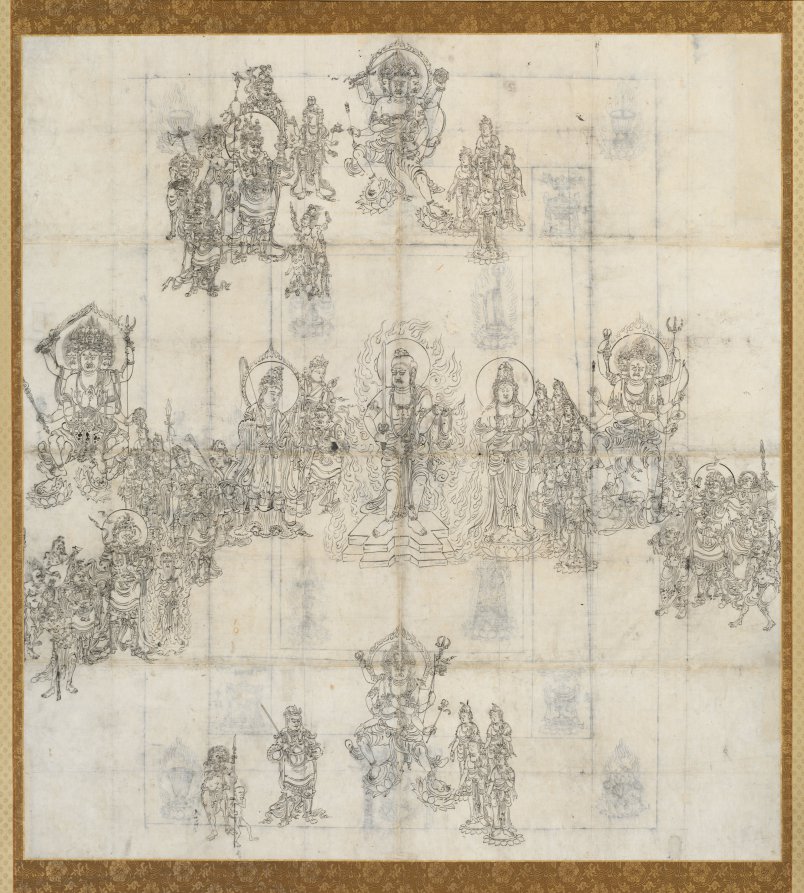
Iconographical Sketch (Zuzō) for the "Benevolent Kings Sutra Mandala" (1100s) is in the Cleveland Museum of Art collection.
The work and its context
The museum's open-access catalogue describes the work:
The Benevolent Kings Sutra has been a highly valued Buddhist scripture in Japan since the Nara period (710–794), when it started to be recited in a ceremony to pray for the peace and protection of the country. In the 800s, the monk Kūkai brought back from China a new translation of the text as well as Buddhist iconographic sketches to perform the rituals based on the sutra. Five scroll sets of copies of the original sketches brought by Kūkai are preserved in Daigoji and Tōji temples in Kyoto. This sketch, which has figural depictions of deities on the front and deities symbolized by objects on the back, differs in some ways from each of those sets, and represents an alternate approach to creating a mandala based on the Benevolent Kings Sutra.
Object facts
- Title: Iconographical Sketch (Zuzō) for the "Benevolent Kings Sutra Mandala"
- Date: 1100s
- Culture: Japan, Heian period (794–1185)
- Type: Painting
- Technique: Hanging scroll; ink on paper
- Dimensions: Image: 122.2 x 112.2 cm (48 1/8 x 44 3/16 in.); Mounted: 203.4 x 130.7 cm (80 1/16 x 51 7/16 in.)
- Collection: ASIAN - Hanging scroll
- Department: Japanese Art
- Accession number: 1987.39
A detail from the museum
The deity at the center is Fudō Myōō, the Immovable One.
Collection credit
Leonard C. Hanna Jr. Fund
Further reading listed by the museum
- Turner, Evan H. “The Year in Review for 1987.” The Bulletin of the Cleveland Museum of Art 75, no. 2 (1988): 30–71.
- Tōyō kaiga no seika: tokubetsuten: Kurīvurando Bijutsukan no korekushon kara [東洋絵画の精華: 特别展: クリーヴラント美術館のコレクションから= Highlights of Asian painting from the Cleveland Museum of Art]. Nara, Japan: Nara National Museum, 1998.
- Admired from afar: masterworks of Japanese painting from the Cleveland Museum of Art [クリーブランド美術館展: 名画でたどる日本の美= Kurīburando Bijutsukan ten: meiga de tadoru Nihon no bi ]. Tokyo: Tōkyō Kokuritsu Hakubutsukan, 2014.
View the collection record
See the museum's photographs and full catalogue entry. Catalogue text is reproduced from the Cleveland Museum of Art's open-access data, with HTML formatting removed. This object and its supplied image are designated CC0.
Sources
More in Lifestyle
Keep reading