Ikat tiraz (900s): Art, History and Details
Ikat tiraz at the Cleveland Museum of Art: 900s, Cotton and gold leaf: resist-dyed warp (ikat); plain weave with inscription. Explore the work's context, creator attribution and collection history.
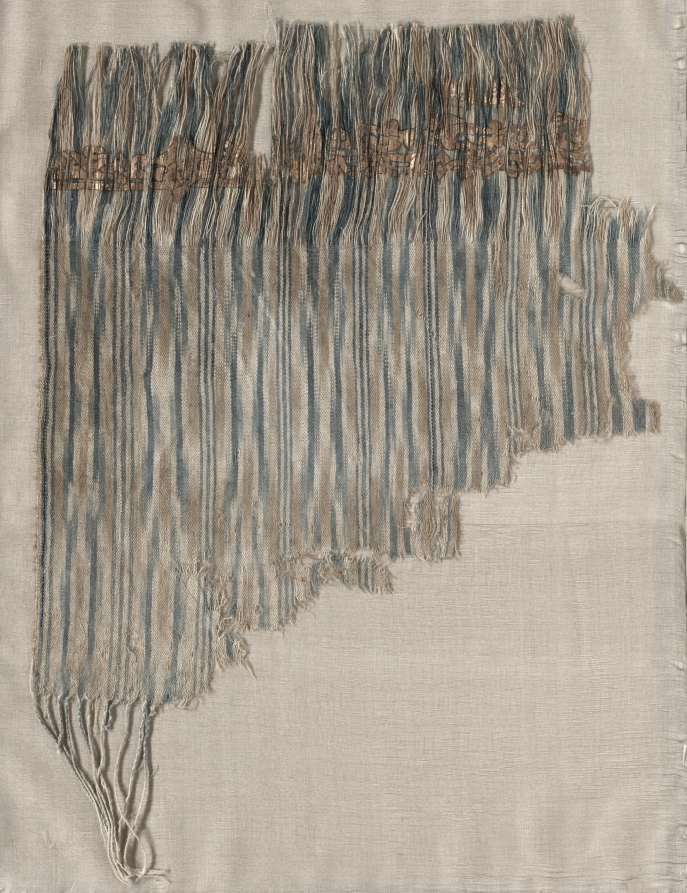
Ikat tiraz (900s) is in the Cleveland Museum of Art collection.
The work and its context
The museum's open-access catalogue describes the work:
The "flame" pattern was dyed on the vertical warp threads before weaving began by tightly binding them to resist dye penetration, and repeated for each color. The process and fabric are called ikat, a Malaysian word which may have originated in South Arabia. Yemeni ikats with historical Arabic inscriptions from the 10th century are among the oldest known. This text, written in Kufic script with gold leaf outlined in black, is so damaged that it cannot be read.
Object facts
- Title: Ikat tiraz
- Date: 900s
- Culture: Yemen, San'a, Reign of Rassid Imams
- Type: Textile
- Technique: Cotton and gold leaf: resist-dyed warp (ikat); plain weave with inscription
- Dimensions: Overall: 41.7 x 30 cm (16 7/16 x 11 13/16 in.)
- Collection: Textiles
- Department: Textiles
- Accession number: 1950.524
Collection credit
John L. Severance Fund
Further reading listed by the museum
- Institut français d'archéologie orientale du Caire, Etienne Combe, Jean Sauvaget, and Gaston Wiet. Répertoire chronologique d'épigraphie arabe. Le Caire: Impr. de l'Institut français d'archéologie orientale, 1931.
- Wiet, Gaston. 1935. “Tissus Et Tapisseries Du Musée Arabe Du Caire.” Syria 16 (3): 278–290.
- Lamm, C. J. Cotton in Mediaeval Textiles of the Near East. Paris: P. Geuthner, 1937.
View the collection record
See the museum's photographs and full catalogue entry. Catalogue text is reproduced from the Cleveland Museum of Art's open-access data, with HTML formatting removed. This object and its supplied image are designated CC0.
Sources
More in Lifestyle
Keep reading