Illuminated page (verso), from a Panj Ganj (Five Treasures) of Abd al- Rahman Jami (Persian, 1414–1492) with two Persian masnavis: Yusuf va Zulaykha (Joseph and Zulaykha) and Khirad-nama-i Iskandari (
Illuminated page (verso), from a Panj Ganj (Five Treasures) of Abd al- Rahman Jami (Persian, 1414–1492) with two Persian masnavis: Yusuf va Zulaykha (Joseph and Zulaykha) and Khirad-nama-i Iskandari (Alexander’s Book of Wisdom) at the Cleve
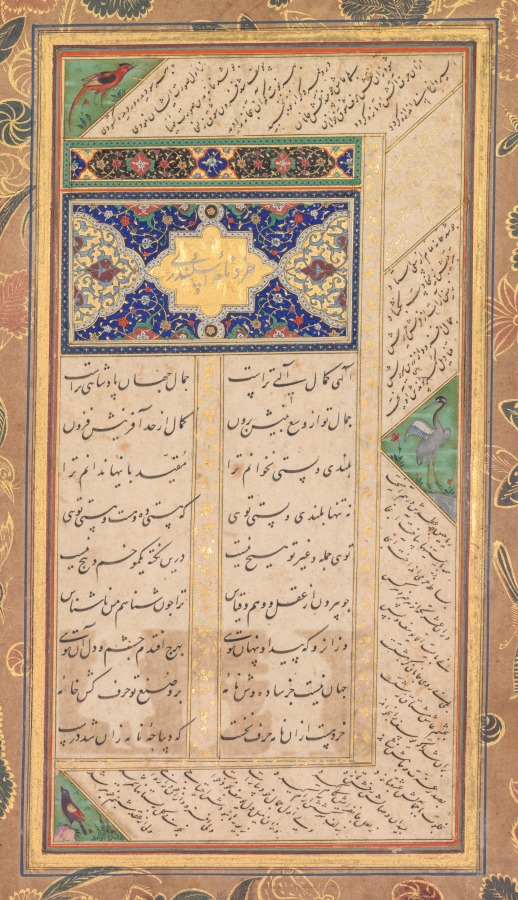
Illuminated page (verso), from a Panj Ganj (Five Treasures) of Abd al- Rahman Jami (Persian, 1414–1492) with two Persian masnavis: Yusuf va Zulaykha (Joseph and Zulaykha) and Khirad-nama-i Iskandari (Alexander’s Book of Wisdom) (1603–7) is in the Cleveland Museum of Art collection. The museum's creator attribution is Mushfiq (Indian, active early 1600s); Sultan 'Ali al-Mashadi (Iranian, 1430–1520).
The work and its context
The museum's open-access catalogue describes the work:
This section of text from Jami’s poem of Joseph and Zulaykha, written diagonally in the margins, describes the beauties of Zulaykha’s house, in which she intends to seduce Joseph. It includes the following verses: Jeweled lamps on the walls were hung / And odorous herbs were beneath them flung. / She gathered together all things most fair, / And unrolled the carpet of pleasure there. / But amid the charms of the sumptuous hall / She longed only for Joseph, far dearer than all. / A heavenly palace is dark and dim / To a lover whose darling is far from him. The longing of Zulaykha for Joseph metaphorically describes an imperfect devotee’s mystical love for God. With patience, forbearance, and virtuous actions, unification with the divine will eventually occur, even for the most flawed among us. On this page also begins the Khirad-nama-i Iskandari (Alexander’s Book of Wisdom), another of the five narrative poems that make up the Panj Ganj.
Object facts
- Title: Illuminated page (verso), from a Panj Ganj (Five Treasures) of Abd al- Rahman Jami (Persian, 1414–1492) with two Persian masnavis: Yusuf va Zulaykha (Joseph and Zulaykha) and Khirad-nama-i Iskandari (Alexander’s Book of Wisdom)
- Date: 1603–7
- Creator attribution: Mushfiq (Indian, active early 1600s); Sultan 'Ali al-Mashadi (Iranian, 1430–1520)
- Culture: Western Afghanistan, Herat (text); Mughal India (paintings)
- Type: Painting
- Technique: Gum tempera, ink, and gold on paper
- Dimensions: Text area: 17.8 x 9.5 cm (7 x 3 3/4 in.); Page: 31.6 x 20.4 cm (12 7/16 x 8 1/16 in.)
- Collection: Indian Art - Mughal
- Department: Indian and Southeast Asian Art
- Accession number: 2013.315.1.b
Collection credit
Gift in honor of Madeline Neves Clapp; Gift of Mrs. Henry White Cannon by exchange; Bequest of Louise T. Cooper; Leonard C. Hanna Jr. Fund; From the Catherine and Ralph Benkaim Collection
Further reading listed by the museum
- Mace, Sonya Rhie. Mughal Paintings: Art and Stories: The Cleveland Museum of Art. London: D. Giles Limited, 2016.
View the collection record
See the museum's photographs and full catalogue entry. Catalogue text is reproduced from the Cleveland Museum of Art's open-access data, with HTML formatting removed. This object and its supplied image are designated CC0.
Sources
- Illuminated page (verso), from a Panj Ganj (Five Treasures) of Abd al- Rahman Jami (Persian, 1414–1492) with two Persian masnavis: Yusuf va Zulaykha (Joseph and Zulaykha) and Khirad-nama-i Iskandari (Alexander’s Book of Wisdom) (1603–7; Cleveland 2013.315.1.b) — Cleveland Museum of Art
- Cleveland Museum of Art Open Access
More in Lifestyle
Keep reading