Imperial Red Cross Easter Egg (1915): Art, History and Details
Imperial Red Cross Easter Egg at the Cleveland Museum of Art: 1915, gold, silver gilt, enamel, glass, ivory. Explore the work's context, creator attribution and collection history.
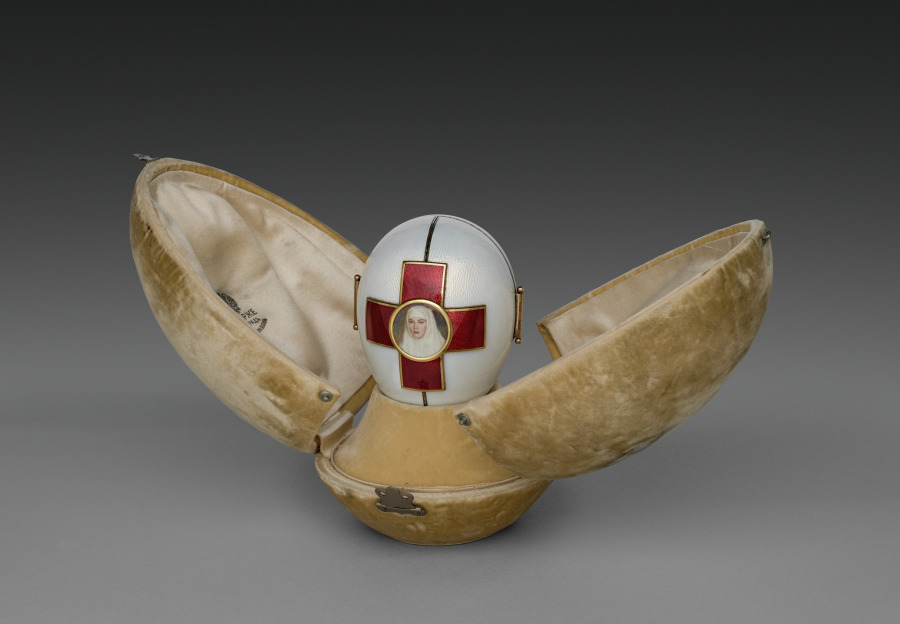
Imperial Red Cross Easter Egg (1915) is in the Cleveland Museum of Art collection. The museum's creator attribution is Peter Carl Fabergé (Russian, 1846–1920); Henrik Wigström (Russian, 1862–1923); House of Fabergé (Russian, 1842–1918).
The work and its context
The museum's open-access catalogue describes the work:
The House of Fabergé made two imperial Easter eggs in 1915 that honored the contributions of Tsarina Alexandra and her two eldest daughters, Olga and Tatiana, to the war effort as Red Cross Sisters of Mercy. Compared to other Fabergé eggs elaborately ornamented with jewels, the eggs reflected the mood of austerity in Russia during World War I. This version becomes an icon when opened, revealing miniatures of the patron saints of the tsarina’s daughters. After the Russian Revolution, this relic of the Tsarist past was sold by the Soviet government to raise needed cash for the treasury.
Object facts
- Title: Imperial Red Cross Easter Egg
- Date: 1915
- Creator attribution: Peter Carl Fabergé (Russian, 1846–1920); Henrik Wigström (Russian, 1862–1923); House of Fabergé (Russian, 1842–1918)
- Culture: Russia, St. Petersburg
- Type: Miscellaneous
- Technique: gold, silver gilt, enamel, glass, ivory
- Dimensions: Overall: 8.6 x 6.4 cm (3 3/8 x 2 1/2 in.)
- Collection: Decorative Arts
- Department: Decorative Art and Design
- Accession number: 1963.673
A detail from the museum
This egg was confiscated by the Bolsheviks during the Russian Revolution and sold by the government of Josef Stalin in the 1930s to raise money for the Soviet treasury.
Collection credit
The India Early Minshall Collection
Further reading listed by the museum
- Hawley, Henry H. Fabergé and His Contemporaries: The India Early Minshall Collection of the Cleveland Museum of Art. Cleveland, OH: Cleveland Museum of Art, 1967.
- Habsburg, Géza von, and David Park Curry. Fabergé in America. New York, NY: Thames and Hudson, 1996.
- Tillander-Godenhielm, Ulla, and Peter Carl Fabergé. Fabergé: ja hänen suomalaiset mestarinsa. Helsinki: Kustannusosakeyhtiö Tammi, 2008.
View the collection record
See the museum's photographs and full catalogue entry. Catalogue text is reproduced from the Cleveland Museum of Art's open-access data, with HTML formatting removed. This object and its supplied image are designated CC0.
Sources
More in Lifestyle
Keep reading