Incense Burner (1893–1914): Art, History and Details
Incense Burner at the Cleveland Museum of Art: 1893–1914, Porcelain with coral red and crackled glaze. Explore the work's context, creator attribution and collection history.
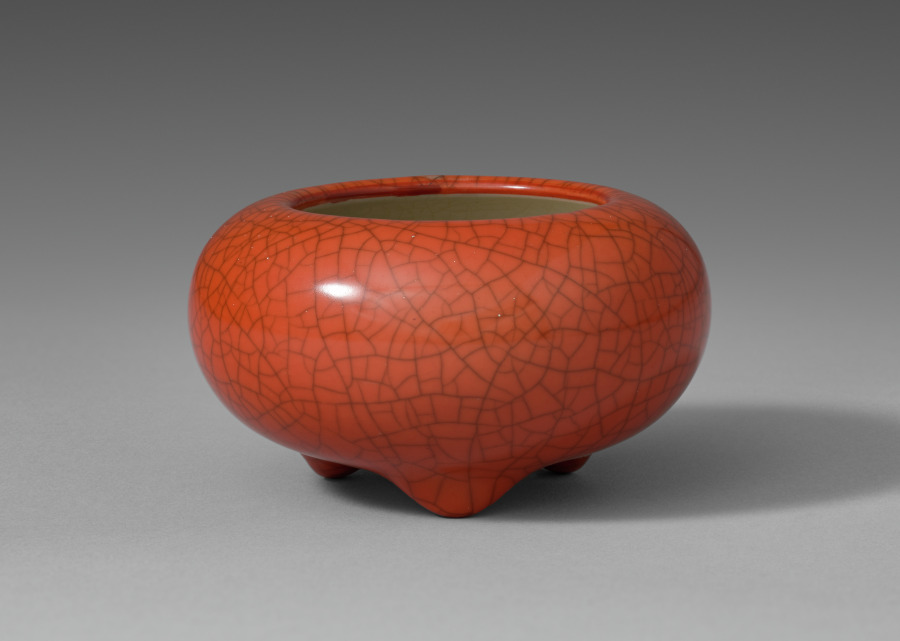
Incense Burner (1893–1914) is in the Cleveland Museum of Art collection. The museum's creator attribution is Seifū Yohei III (Japanese, 1851–1914).
The work and its context
The museum's open-access catalogue describes the work:
The tiniest of containers, this ovoid tripod is an incense burner. It likely once had an openwork metal lid. It is remarkable for its coral red color and crackled glaze. In contrast to the exterior, the interior has been left white under a transparent glaze. The “coral red glaze” is one Yohei III developed in 1887 and called sangōyu. Sensational among colors known at that time, Yohei III won first prize for his work glazed with it at the annual exhibition of the Japan Art Association (Bijutsu Kyokai) in 1888.
Object facts
- Title: Incense Burner
- Date: 1893–1914
- Creator attribution: Seifū Yohei III (Japanese, 1851–1914)
- Culture: Japan, Meiji period (1868–1912)
- Type: Ceramic
- Technique: Porcelain with coral red and crackled glaze
- Dimensions: 5.3 x 9.1 cm (2 1/16 x 3 9/16 in.)
- Collection: Japanese Art
- Department: Japanese Art
- Accession number: 2022.193
A detail from the museum
Seifū Yohei III’s incense burner has a red glaze that is difficult to achieve.
Collection credit
Gift of James and Christine Heusinger
Further reading listed by the museum
- Maezaki, Shinya and Sinéad Vilbar. Colors of Kyoto: The Seifū Yohei Ceramic Studio. Cleveland, OH: The Cleveland Museum of Art, 2023.
View the collection record
See the museum's photographs and full catalogue entry. Catalogue text is reproduced from the Cleveland Museum of Art's open-access data, with HTML formatting removed. This object and its supplied image are designated CC0.
Sources
More in Lifestyle
Keep reading