Incense Burner (late 1300s): Art, History and Details
Incense Burner at the Cleveland Museum of Art: late 1300s, black lacquer on wood with decoration in maki-e; metal rims; bronze lid. Explore the work's context, creator attribution and collection history.
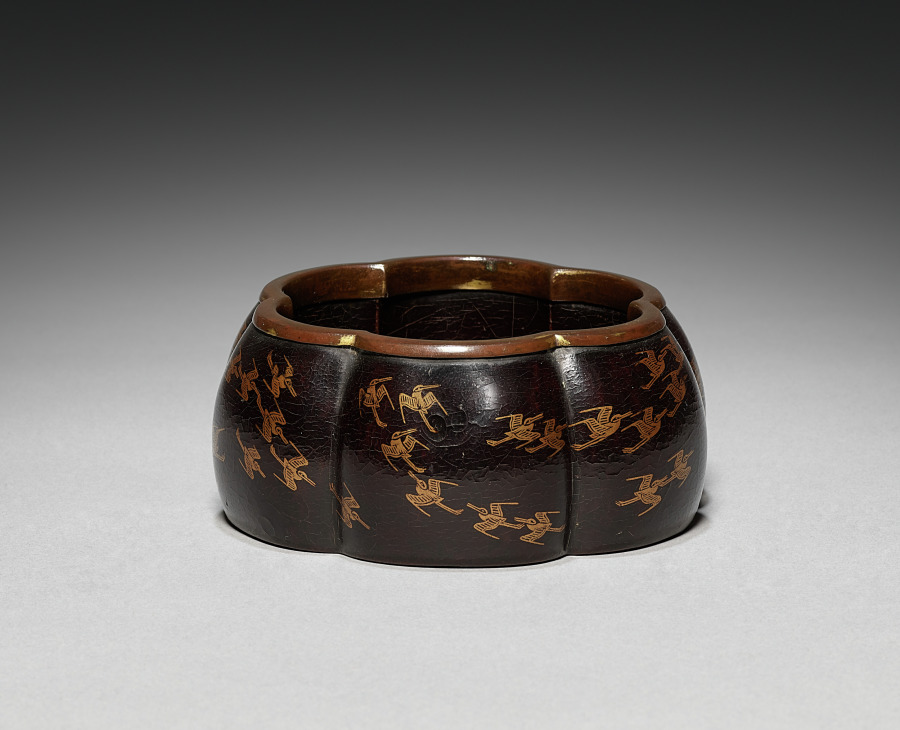
Incense Burner (late 1300s) is in the Cleveland Museum of Art collection.
The work and its context
The museum's open-access catalogue describes the work:
This container's repeated, undulating, rounded sides evoke waves over which the articulated plovers sweep. The bronze cover (probably a later addition) mimics the design of a fishing weir. Overall, the container brings to mind the seashore. The earthy quality of the lacquered surface demonstrates the interaction between a man-made pattern (the plovers) and the somewhat unexpected surface of a natural material such as wood.
Object facts
- Title: Incense Burner
- Date: late 1300s
- Culture: Japan, Nanbokuchō period (1336–92)
- Type: Lacquer
- Technique: black lacquer on wood with decoration in maki-e; metal rims; bronze lid
- Dimensions: Overall: 7.7 x 10.8 cm (3 1/16 x 4 1/4 in.)
- Collection: Japanese Art
- Department: Japanese Art
- Accession number: 1960.195.a
Collection credit
Purchase from the J. H. Wade Fund
Further reading listed by the museum
- Lee, Sherman E. “Year in Review| 1960.” The Bulletin of the Cleveland Museum of Art, vol. 47, no. 10, 1960, pp. 223–254.
- Lee, Sherman E. Japanese Decorative Style. Tokyo: Makoto Nakao, 1962.
- Mayuyama, Junkichi 繭山順吉. Japanese Art in the West. [Tokyo]: Mayuyama & Co, 1966.
View the collection record
See the museum's photographs and full catalogue entry. Catalogue text is reproduced from the Cleveland Museum of Art's open-access data, with HTML formatting removed. This object and its supplied image are designated CC0.
Sources
More in Lifestyle
Keep reading