Ink Flowers (1361): Art, History and Details
Ink Flowers at the Cleveland Museum of Art: 1361, Handscroll; ink on paper. Explore the work's context, creator attribution and collection history.
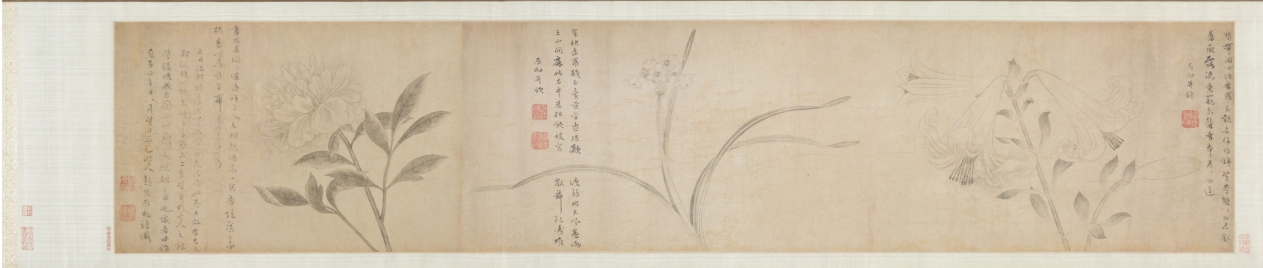
Ink Flowers (1361) is in the Cleveland Museum of Art collection. The museum's creator attribution is Zhao Zhong (Chinese, second half of the 1300s).
The work and its context
The museum's open-access catalogue describes the work:
Zhao Zhong's flowers, each paired with a poem, echo the fine-style colored flowers of the academic tradition, but instead he used only ink. Fine lines define the contours of each plant, as well as the veins within each petal and leaf. Careful ink washes give subtle modeling to the forms. The combination of lily, narcissus, and peony is unusual as the three belong to no known seasonal or symbolic system popular in the fourteenth century. Zhao’s medical training may have influenced the selection. Powdered lilies, for example, were prescribed to dispel grief, while the bark of tree peony roots was used as a treatment for various blood disorders.
Object facts
- Title: Ink Flowers
- Date: 1361
- Creator attribution: Zhao Zhong (Chinese, second half of the 1300s)
- Culture: China, Yuan dynasty (1271–1368)
- Type: Painting
- Technique: Handscroll; ink on paper
- Dimensions: Overall: 31.8 x 153.2 cm (12 1/2 x 60 5/16 in.)
- Collection: ASIAN - Handscroll
- Department: Chinese Art
- Accession number: 1967.36
A detail from the museum
This handscroll is a very rare example of ink flowers in the linear baimiao style of the fourteenth century.
Collection credit
John L. Severance Fund
Further reading listed by the museum
- Tō Sō Gen Min meigaten-gō [唐宋元明名画展号]. Tōkyō: Tōkyō Asahi Shinbun Hakkōjo, 1928.
- Xie, Zhiliu 谢稚柳. Tang wu dai song yuan ming ji 唐五代宋元名迹. Shanghai: Gu dian wen xue chu ban she 古典文学出版社, 1957.
- “Year in Review.” The Bulletin of the Cleveland Museum of Art, vol. 54, no. 10, 1967, pp. 302–346.
View the collection record
See the museum's photographs and full catalogue entry. Catalogue text is reproduced from the Cleveland Museum of Art's open-access data, with HTML formatting removed. This object and its supplied image are designated CC0.
Sources
More in Lifestyle
Keep reading