Inkstone in the Form of a Koto (1600s): Art, History and Details
Inkstone in the Form of a Koto at the Cleveland Museum of Art: 1600s, Stoneware with underglaze iron decoration (Shino ware, Mino type). Explore the work's context, creator attribution and collection history.
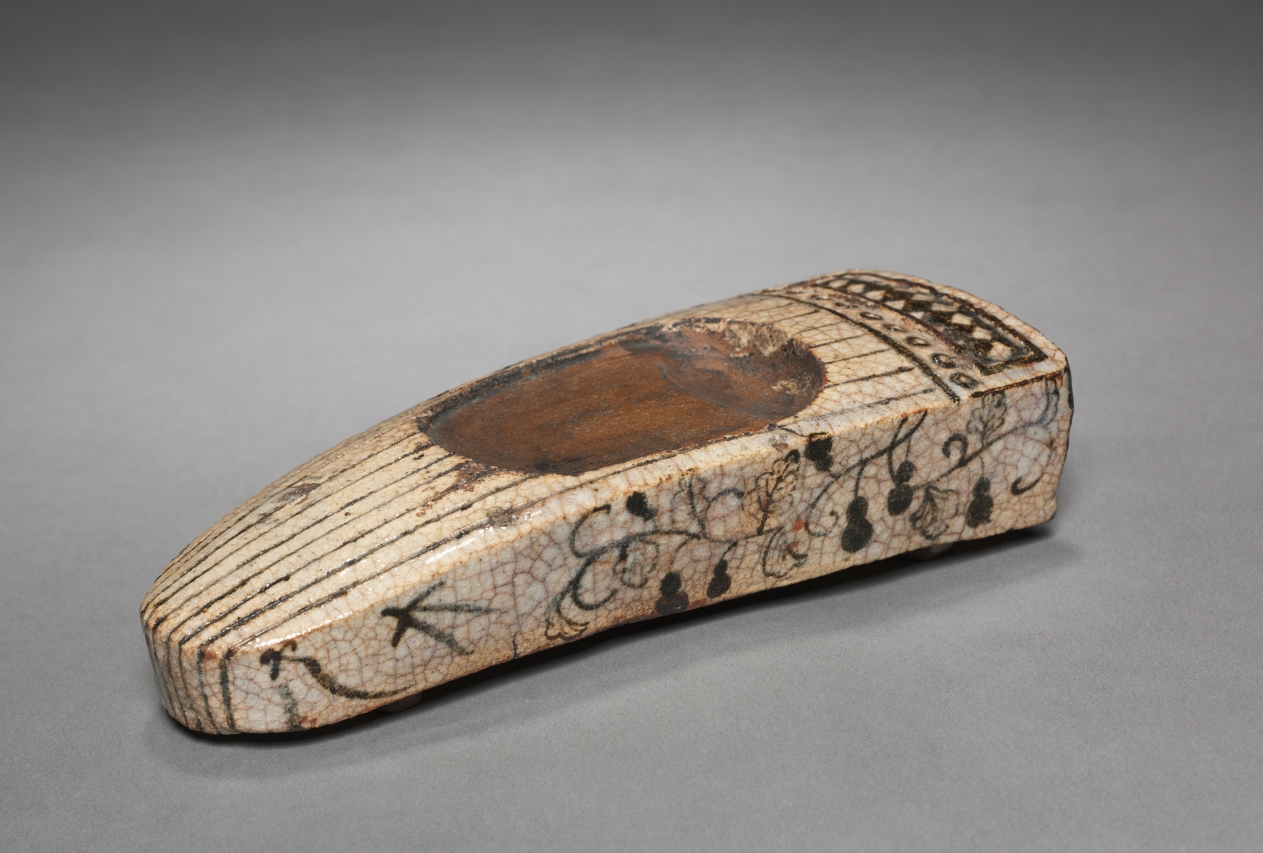
Inkstone in the Form of a Koto (1600s) is in the Cleveland Museum of Art collection.
The work and its context
The museum's open-access catalogue describes the work:
This hollow ink stone shaped like a musical instrument called a koto reflects the witty idea that music can inspire writing. The koto’s string and bridge were incised into the clay and then painted with underglaze iron pigment.
Object facts
- Title: Inkstone in the Form of a Koto
- Date: 1600s
- Culture: Japan, Momoyama period (1573-1615) to Edo period (1615-1858)
- Type: Ceramic
- Technique: Stoneware with underglaze iron decoration (Shino ware, Mino type)
- Dimensions: Overall: 4.4 x 19.2 x 7 cm (1 3/4 x 7 9/16 x 2 3/4 in.)
- Collection: Japanese Art
- Department: Japanese Art
- Accession number: 1971.168
Collection credit
Gift of Mr. and Mrs. Harry H. Stone
Further reading listed by the museum
- Lee, Sherman E. “The Year in Review for 1971.” The Bulletin of the Cleveland Museum of Art 59, no. 1 (February 1972): 3–46.
- Sŏn, Sŭng-hye. The Lure of Painted Poetry: Japanese and Korean Art. Cleveland, OH: The Cleveland Museum of Art, 2011.
View the collection record
See the museum's photographs and full catalogue entry. Catalogue text is reproduced from the Cleveland Museum of Art's open-access data, with HTML formatting removed. This object and its supplied image are designated CC0.
Sources
More in Lifestyle
Keep reading