Inkwell and Candlestick with the Infant Hercules Killing the Serpents (c. 1510–20): Art, History and Details
Inkwell and Candlestick with the Infant Hercules Killing the Serpents at the Cleveland Museum of Art: c. 1510–20, bronze. Explore the work's context, creator attribution and collection history.
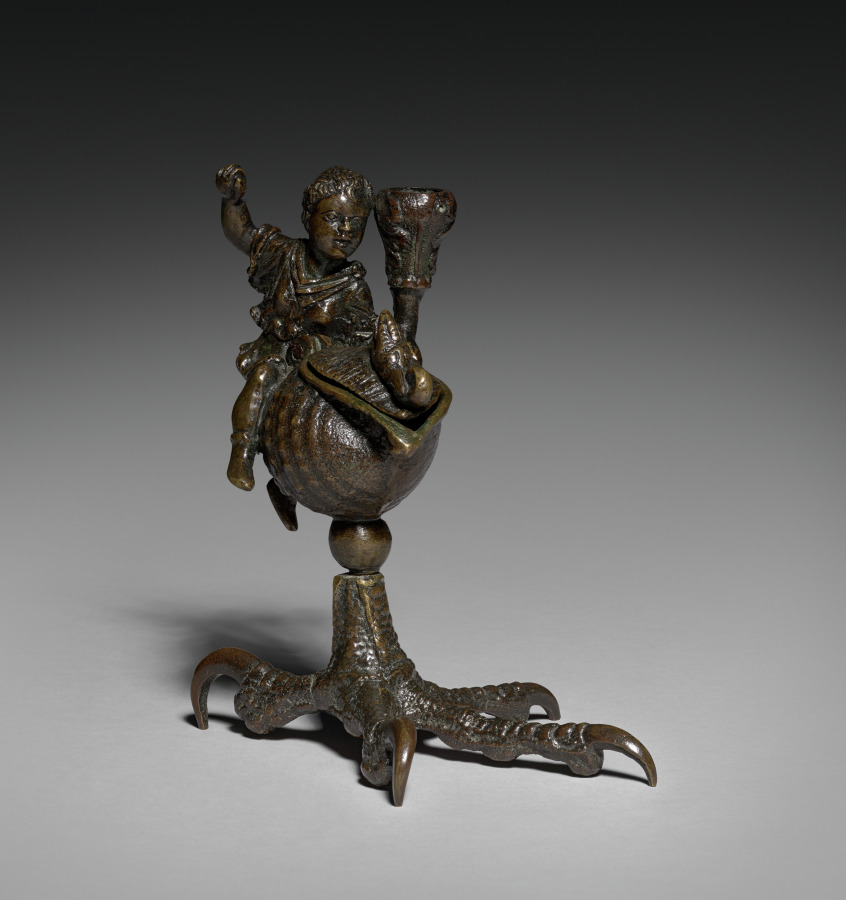
Inkwell and Candlestick with the Infant Hercules Killing the Serpents (c. 1510–20) is in the Cleveland Museum of Art collection. The museum's creator attribution is Severo da Ravenna (Italian, c. 1496–c. 1543).
The work and its context
The museum's open-access catalogue describes the work:
In the early 1500s, Padua, a center of strong humanist traditions, encouraged the revival of classicism, and artists took their cues from descriptions in the works of classical authors. Classical small-scale bronzes grew in demand, and in response, the city's bourgeoning foundries produced a varied and extensive supply of small statues. Like many early Paduan bronzes, this work's utilitarian function—used to hold ink and to supply light—is complimented by its ornamental value. The base consists of an eagle claw, cast from life, supporting an equally realistic nautilus shell. Though medieval artists had occasionally used seashells to hold paints, the shell inkwell, whose small size makes it rather impractical to use, was a motif particular to Padua. Perched upon the shell is most likely Hercules, the son of Zeus. Perhaps aided by a staff (now missing) he is poised to strike a serpent, which according to myth was sent by Hera, the jealous wife of Zeus, to kill him. The dramatic opposition of hero and monster enhances the connection to the classical past, further meeting the desires of the educated patrons of Padua.
Object facts
- Title: Inkwell and Candlestick with the Infant Hercules Killing the Serpents
- Date: c. 1510–20
- Creator attribution: Severo da Ravenna (Italian, c. 1496–c. 1543)
- Culture: Italy, Ravenna, 16th century
- Type: Sculpture
- Technique: bronze
- Dimensions: Overall: 21 x 11 x 13 cm (8 1/4 x 4 5/16 x 5 1/8 in.)
- Collection: Sculpture
- Department: European Painting and Sculpture
- Accession number: 1954.798
Collection credit
John L. Severance Fund
Further reading listed by the museum
- Winter, Patrick M. de. “Recent Accessions of Italian Renaissance Decorative Arts, Part I: Incorporating Notes on the Sculptor Severo Da Ravenna.” The Bulletin of the Cleveland Museum of Art 73, no. 3 (March 1986): 74–138.
- Cleveland Museum of Art. Images of the Mind. Cleveland, Ohio: Cleveland Museum of Art, 1987.
View the collection record
See the museum's photographs and full catalogue entry. Catalogue text is reproduced from the Cleveland Museum of Art's open-access data, with HTML formatting removed. This object and its supplied image are designated CC0.
Sources
More in Lifestyle
Keep reading