Inro (Case) with Egrets and Willows (1700s): Art, History and Details
Inro (Case) with Egrets and Willows at the Cleveland Museum of Art: 1700s, Lacquer on wood with sprinkled gold powder design (maki-e) and gold-foil-and-shell inlay (Somada style). Explore the work's context, creator attribution and collecti
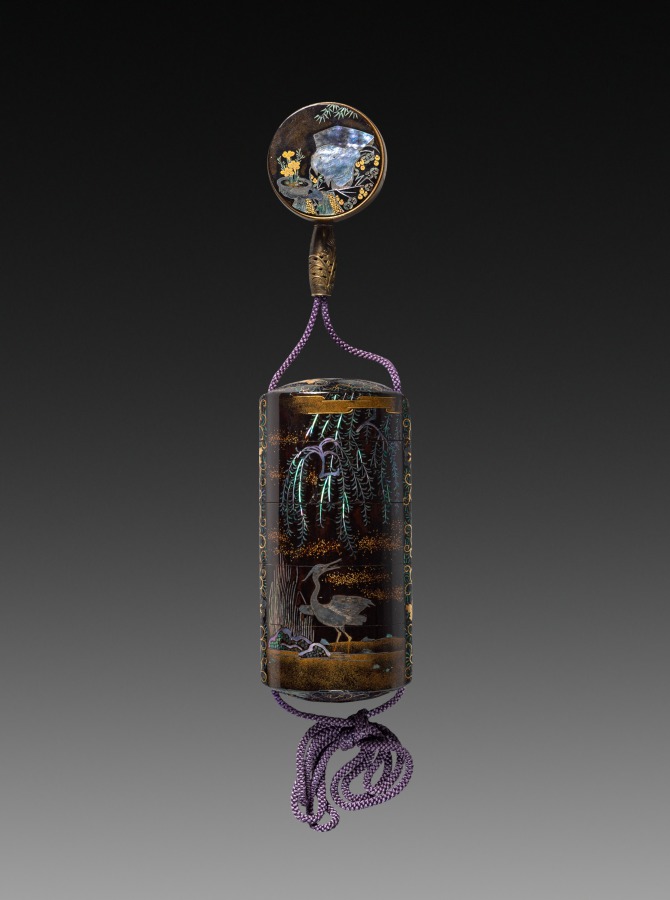
Inro (Case) with Egrets and Willows (1700s) is in the Cleveland Museum of Art collection.
The work and its context
The museum's open-access catalogue describes the work:
The iridescence of this inro is due to the shell inlay used to form the design of an egret (a waterfowl) standing among reeds in water beneath a weeping willow on one side and an egret resting in a tree on the other. The metal ojime (cinch) has a floral design, and the round lacquer netsuke, or toggle, has an image of a Chinese gentleman, possibly an immortal, holding flowers planted in a shallow pot.
Object facts
- Title: Inro (Case) with Egrets and Willows
- Date: 1700s
- Culture: Japan, Edo period (1615–1868)
- Type: Lacquer
- Technique: Lacquer on wood with sprinkled gold powder design (maki-e) and gold-foil-and-shell inlay (Somada style)
- Dimensions: Overall: 9.9 x 4.8 cm (3 7/8 x 1 7/8 in.)
- Collection: Japanese Art
- Department: Japanese Art
- Accession number: 1916.866
Collection credit
Gift of D. Z. Norton
View the collection record
See the museum's photographs and full catalogue entry. Catalogue text is reproduced from the Cleveland Museum of Art's open-access data, with HTML formatting removed. This object and its supplied image are designated CC0.
Sources
More in Lifestyle
Keep reading


