Inscribed Tombstone of Shaikh al-Husain ibn Abdallah ibn al-Hasan (died 1110) (1110): Art, History and Details
Inscribed Tombstone of Shaikh al-Husain ibn Abdallah ibn al-Hasan (died 1110) at the Cleveland Museum of Art: 1110, limestone. Explore the work's context, creator attribution and collection history.
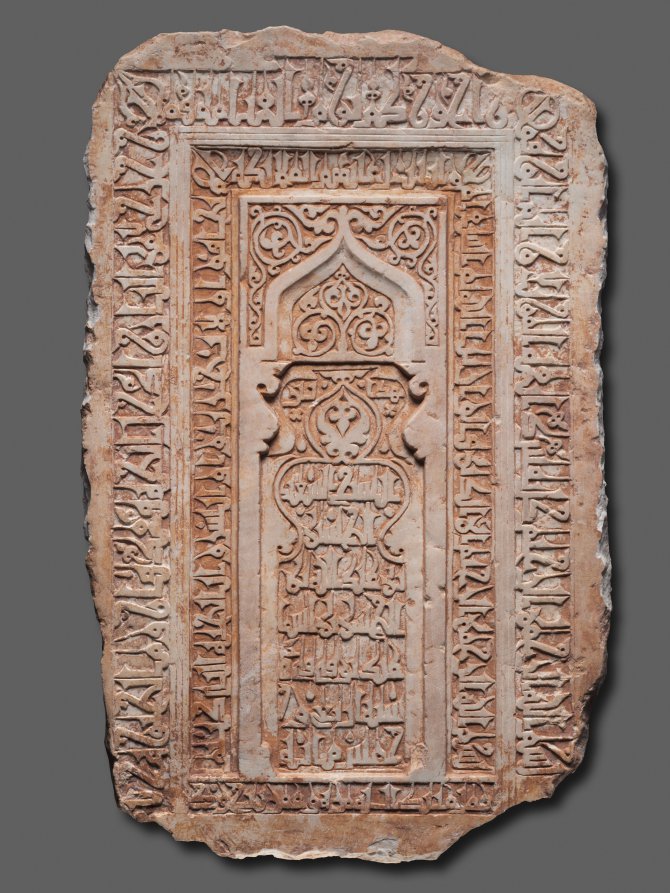
Inscribed Tombstone of Shaikh al-Husain ibn Abdallah ibn al-Hasan (died 1110) (1110) is in the Cleveland Museum of Art collection.
The work and its context
The museum's open-access catalogue describes the work:
Arabic calligraphy, the supreme art form in the Islamic world, enhances this tombstone. The elegant Arabic script embellished with leaf tendrils at the top of the tall letters is called floriated Kufic. Verses about paradise from the holy Qur'an border the central arch-shaped niche that resembles a mosque's mihrab, located in the wall closest to the holy city of Mecca. The name of the deceased and the year of his death are recorded within the niche above the names of the carvers: "The work of Abaidallah Murra(?) and 'Umar(?)." The inscriptions from the Qur'an translate as follows: Outer border (read from right to left): "In the name of God, the Merciful, the Compassionate. Every soul shall taste of death; and ye shall only receive your recompenses on the Day of Resurrection. And who so shall escape the fire, and be brought into Paradise, shall be happy. And the life [of this world is but a cheating fruition]" (3:185). Inner border: "In the name of God, the Merciful, the Compassionate. But as for those who say, 'Our Lord is God'; and who go straight to Him, the Angels shall descend to them and say 'Fear ye not, neither be ye grieved, but rejoice ye in the Paradise which ye have been [promised]'" (41:30).
Object facts
- Title: Inscribed Tombstone of Shaikh al-Husain ibn Abdallah ibn al-Hasan (died 1110)
- Date: 1110
- Culture: Iran, Yazd, Seljuk Period, early 12th Century
- Type: Sculpture
- Technique: limestone
- Dimensions: Overall: 65 x 42.6 cm (25 9/16 x 16 3/4 in.)
- Collection: Islamic Art
- Department: Islamic Art
- Accession number: 1950.9
A detail from the museum
More work by these two artisans, Ubaydallah Murra and Umar, survives than by any other single artisan working in Yazd during the 1100s. There are only three other collaborative efforts on twelfth-century mijrabs/tombstones of the Yazd area out of a total number of 18 signed pieces.
Collection credit
Edward L. Whittemore Fund
Further reading listed by the museum
- Milliken, William M. "Part II. Annual Report Issue for the Year 1950." The Bulletin of the Cleveland Museum of Art 38, no. 6 (1951): 151-82.
- The Cleveland Museum of Art. The Cleveland Museum of Art Handbook. Cleveland, OH: The Cleveland Museum of Art, 1958.
- The Cleveland Museum of Art. Handbook of the Cleveland Museum of Art/1966. Cleveland, OH: The Cleveland Museum of Art, 1966.
View the collection record
See the museum's photographs and full catalogue entry. Catalogue text is reproduced from the Cleveland Museum of Art's open-access data, with HTML formatting removed. This object and its supplied image are designated CC0.
Sources
More in Lifestyle
Keep reading