Italo-Geometric Bird Askos (Oil Vessel): Hunter (Herakles?) and Stag (c. 700 BCE): Art, History and Details
Italo-Geometric Bird Askos (Oil Vessel): Hunter (Herakles?) and Stag at the Cleveland Museum of Art: c. 700 BCE, ceramic. Explore the work's context, creator attribution and collection history.
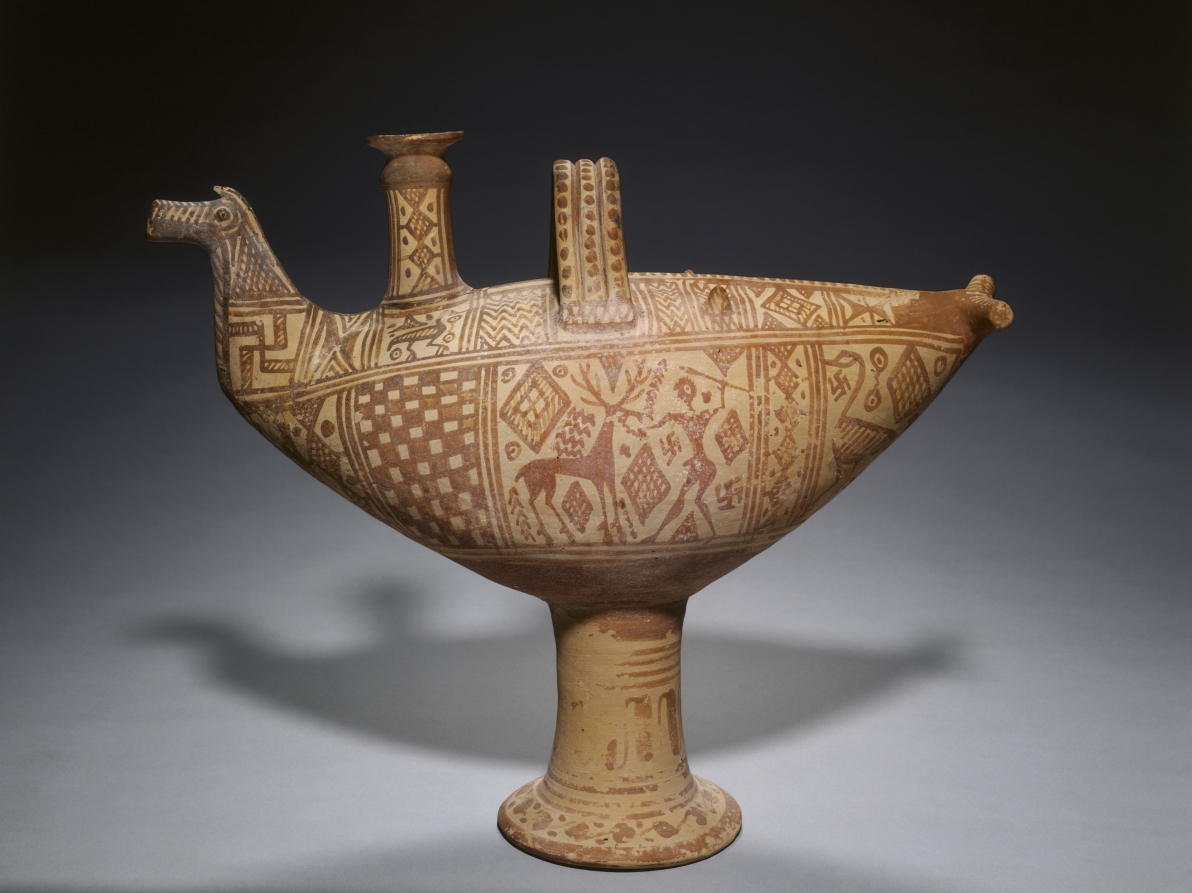
Italo-Geometric Bird Askos (Oil Vessel): Hunter (Herakles?) and Stag (c. 700 BCE) is in the Cleveland Museum of Art collection. The museum's creator attribution is Bisenzio Class.
The work and its context
The museum's open-access catalogue describes the work:
This bird-shaped askos (oil vessel), with a tall filling spout and a pierced beak for pouring, perhaps held perfumed oil for a funerary function. Although the shape likely stems from Italian tradition, the abundantly painted geometric decoration, covering nearly every available surface, derives originally from Greece. Thus scholars have suggested that an immigrant Greek potter working in Etruria may have made the vessel. The sole narrative scene shows a man with a spear leading an antlered animal. If not an anonymous hunter, this could be the earliest known representation of the hero Herakles performing his third labor: capturing the golden-antlered Keryneian hind, or female deer.
Object facts
- Title: Italo-Geometric Bird Askos (Oil Vessel): Hunter (Herakles?) and Stag
- Date: c. 700 BCE
- Creator attribution: Bisenzio Class
- Culture: Etruscan, likely made at Vulci
- Type: Ceramic
- Technique: ceramic
- Dimensions: Overall: 33.5 x 15.5 cm (13 3/16 x 6 1/8 in.); Diameter of foot: 11.9 cm (4 11/16 in.)
- Collection: GR - Etruscan
- Department: Greek and Roman Art
- Accession number: 1993.1
A detail from the museum
This askos may feature the earliest known representation of Herakles's third labor, the Keryneian hind.
Collection credit
Purchase from the J. H. Wade Fund
Further reading listed by the museum
- Beazley Archive. n.d. Beazley Archive Pottery Database. Oxford: Beazley Archive.
- Muscarella, Oscar White. Ancient Art: The Norbert Schimmel Collection. Mainz: P. von Zabern, 1974.
- Brommer, F. "Herakles und die Hirschkuh," Archäologischer Anzeiger (1977).
View the collection record
See the museum's photographs and full catalogue entry. Catalogue text is reproduced from the Cleveland Museum of Art's open-access data, with HTML formatting removed. This object and its supplied image are designated CC0.
Sources
More in Lifestyle
Keep reading