Jar (Hu) (202 BCE–9 CE): Art, History and Details
Jar (Hu) at the Cleveland Museum of Art: 202 BCE–9 CE, earthenware with slip and painted decoration. Explore the work's context, creator attribution and collection history.
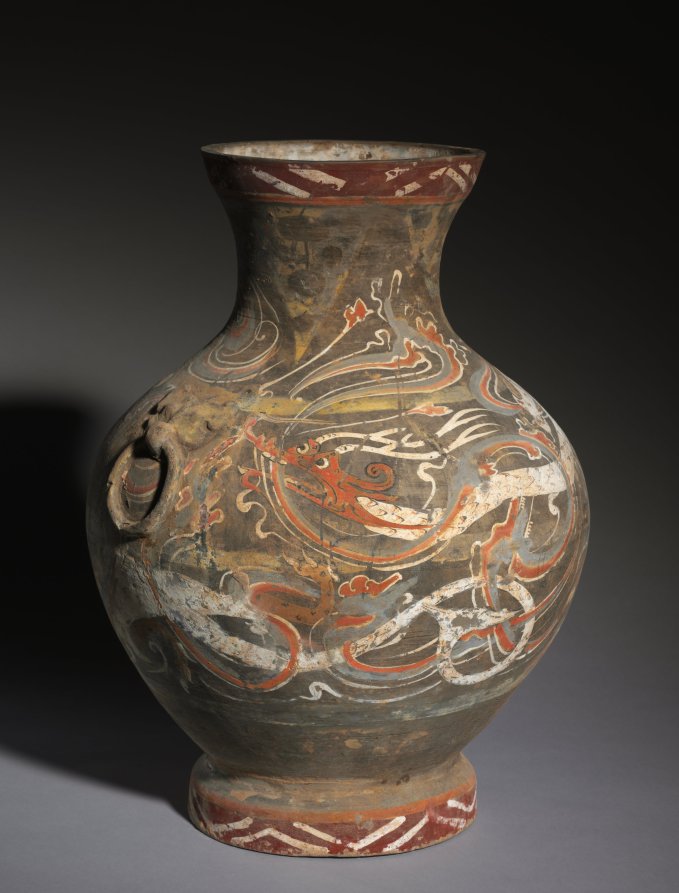
Jar (Hu) (202 BCE–9 CE) is in the Cleveland Museum of Art collection.
The work and its context
The museum's open-access catalogue describes the work:
Instead of depicting a real landscape, the artist focused on the rhythmic forces of nature and the movement of energy, using the scrolling form as a symbol common to all changes in nature: cloud vapors, waves, and mountains alike. Here a dragon hovers among sweeping scrolls.
Object facts
- Title: Jar (Hu)
- Date: 202 BCE–9 CE
- Culture: China, probably Henan province, Western Han dynasty (206 BCE–8 CE)
- Type: Ceramic
- Technique: earthenware with slip and painted decoration
- Dimensions: Overall: 48.2 cm (19 in.)
- Collection: China - Han Dynasty
- Department: Chinese Art
- Accession number: 1989.15
A detail from the museum
This earthenware wine jar's shape mimics costly bronzes, but the handles have rings that are fixed to the surface of the pot, rendering them useless.
Collection credit
The Severance and Greta Millikin Purchase Fund
Further reading listed by the museum
- E. H. T. “The Year in Review: Selections 1989.” The Bulletin of the Cleveland Museum of Art 77, no. 2 (February 1990): 38–78.
- Wilson, J. Keith. "Powerful Form and Potent Symbol: The Dragon in Asia." The Bulletin of the Cleveland Museum of Art 77, no. 8 (1990): 2860323.
- The Cleveland Museum of Art. Handbook of the Cleveland Museum of Art. Cleveland, OH: The Cleveland Museum of Art, 1991.
View the collection record
See the museum's photographs and full catalogue entry. Catalogue text is reproduced from the Cleveland Museum of Art's open-access data, with HTML formatting removed. This object and its supplied image are designated CC0.
Sources
More in Lifestyle
Keep reading