Jar with Four Lugs (500s–600s): Art, History and Details
Jar with Four Lugs at the Cleveland Museum of Art: 500s–600s, stoneware with traces of ash glaze. Explore the work's context, creator attribution and collection history.
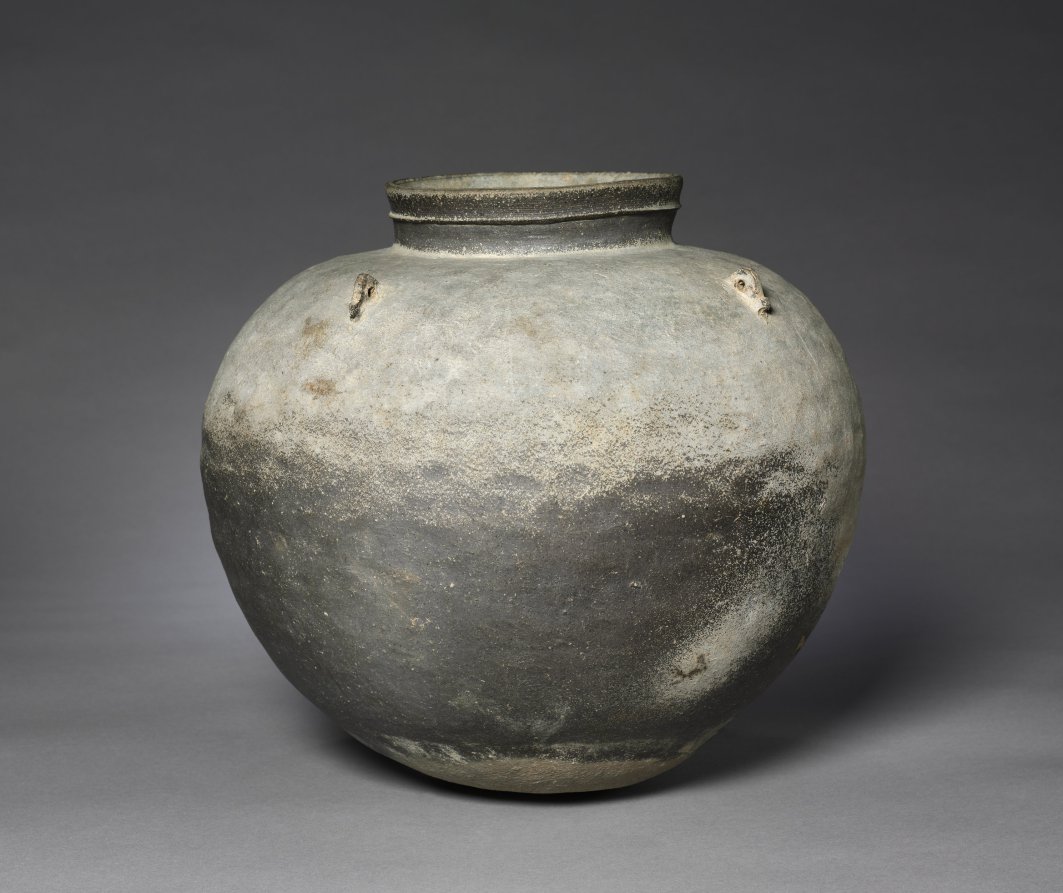
Jar with Four Lugs (500s–600s) is in the Cleveland Museum of Art collection.
The work and its context
The museum's open-access catalogue describes the work:
This storage jar comes from the Paekche kilns. The matte gray surface of ash deposits on the upper body provides an appealing decoration. Paekche potters often employed the pounding technique (tanal in Korean) to treat the surface, a method to strengthen the clay body.
Object facts
- Title: Jar with Four Lugs
- Date: 500s–600s
- Culture: Korea, Three Kingdoms period (57 BCE–668 CE)
- Type: Ceramic
- Technique: stoneware with traces of ash glaze
- Dimensions: Diameter: 32.6 cm (12 13/16 in.); Overall: 29.9 cm (11 3/4 in.)
- Collection: Korean Art
- Department: Korean Art
- Accession number: 1993.43
A detail from the museum
Closed kilns built on hillsides became widely used for producing this type of pottery vessel in Korea during the Three Kingdoms period.
Collection credit
Gift of Hongnam Kim in honor of Evan H. Turner and Michael R. Cunningham
Further reading listed by the museum
- Yim, Seung-deok and Jeong-ho Seo. "A Study of Manufacturing Technique on the Padding Pottery in Sabi-Baekjae Period [百濟 泗沘期 打捺文土器 製作技法 硏究." Muhwa sahak (2011): 97–131.
- “1993 Annual Report.” The Bulletin of the Cleveland Museum of Art 81, no. 6 (July 1994): 143–218.
- Lee, Chang-hyun and Yu-ri Shin. “A Study on Residential areas in Yeongdong District during the Period of the Three Kingdoms [嶺東地方三國時代住居址試論].” Munhwa sahak 33 (2010): 21–61.
View the collection record
See the museum's photographs and full catalogue entry. Catalogue text is reproduced from the Cleveland Museum of Art's open-access data, with HTML formatting removed. This object and its supplied image are designated CC0.
Sources
More in Lifestyle
Keep reading