Jonah Cast Out by the Whale onto the Shore of Nineveh (1566): Art, History and Details
Jonah Cast Out by the Whale onto the Shore of Nineveh at the Cleveland Museum of Art: 1566, Pen and brown ink over indications in black chalk, within brown ink framing lines; indented for transfer. Explore the work's context, creator attrib
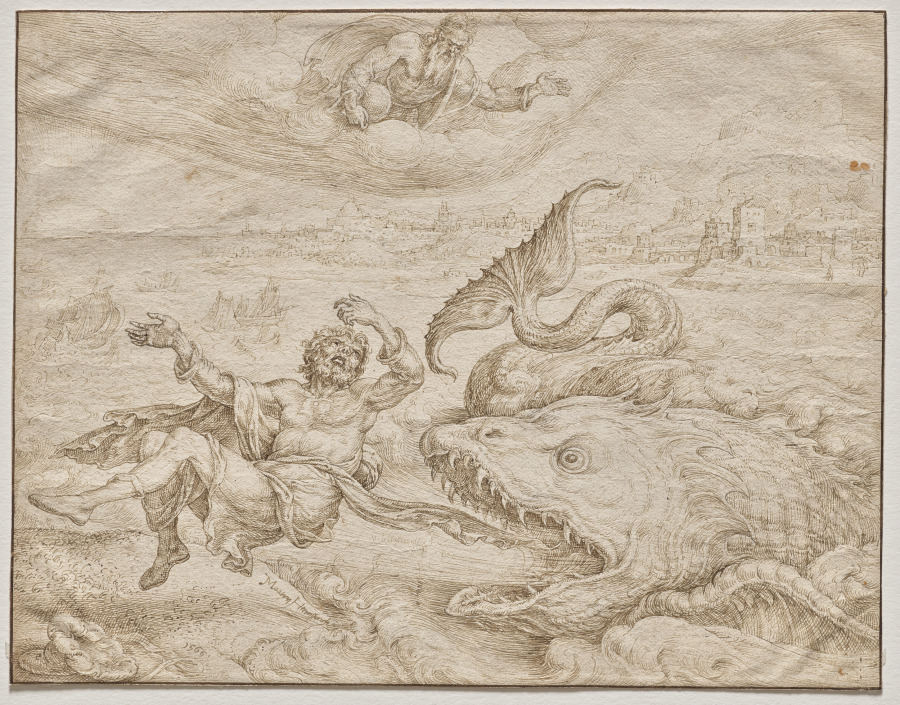
Jonah Cast Out by the Whale onto the Shore of Nineveh (1566) is in the Cleveland Museum of Art collection. The museum's creator attribution is Maarten van Heemskerck (Dutch, 1498–1574).
The work and its context
The museum's open-access catalogue describes the work:
In this dramatic composition, the Old Testament prophet Jonah floats midair after being vomited onto dry land by a giant fish. The artist Maarten van Heemskerck drew the composition as the second of four illustrations of episodes from the biblical book of Jonah, which describes how the prophet was swallowed by a fish and regurgitated after three days. Jonah’s trial was often interpreted as a metaphor for exile and redemption, or for Christ’s resurrection. Heemskerck was one of the most prolific designers of prints in the Netherlands in the mid-1500s. Working with the engraver Philips Galle in his native city of Haarlem, the drawing was indented with a dull knife for transfer onto a copperplate to be engraved. Heemskerck was an instrumental figure in bringing ideas about Italian art to northern Europe. Here, he incorporates architecture and figures reminiscent of types he saw and sketched on a trip to Italy in the 1530s.
Object facts
- Title: Jonah Cast Out by the Whale onto the Shore of Nineveh
- Date: 1566
- Creator attribution: Maarten van Heemskerck (Dutch, 1498–1574)
- Culture: Netherlands
- Type: Drawing
- Technique: Pen and brown ink over indications in black chalk, within brown ink framing lines; indented for transfer
- Dimensions: Sheet: 19.6 x 25 cm (7 11/16 x 9 13/16 in.)
- Collection: DR - Dutch
- Department: Drawings
- Accession number: 2024.28
A detail from the museum
The artist’s rendering of a fish is neither a shark nor a whale, but rather a fictional combination of the two, a product of the artist’s knowledge of ornamental designs and his own imagination.
Collection credit
Leonard C. Hanna Jr. Fund
Further reading listed by the museum
- Nationalmuseum (Sweden). Dutch and Flemish Drawings in the Nationalmuseum and Other Swedish Collections. Stockholm: Nationalmuseum, 1953.
- Veldman, Ilja M., Ger Luijten, and F. W. H. Hollstein. The New Hollstein Dutch & Flemish Etchings, Engravings and Woodcuts, 1450-1700. 1993.
View the collection record
See the museum's photographs and full catalogue entry. Catalogue text is reproduced from the Cleveland Museum of Art's open-access data, with HTML formatting removed. This object and its supplied image are designated CC0.
Sources
More in Lifestyle
Keep reading
Related stories