Kannon (c. 1868–1912): Art, History and Details
Kannon at the Cleveland Museum of Art: c. 1868–1912, hanging scroll; ink and color on silk; inscription in gold ink on silk. Explore the work's context, creator attribution and collection history.
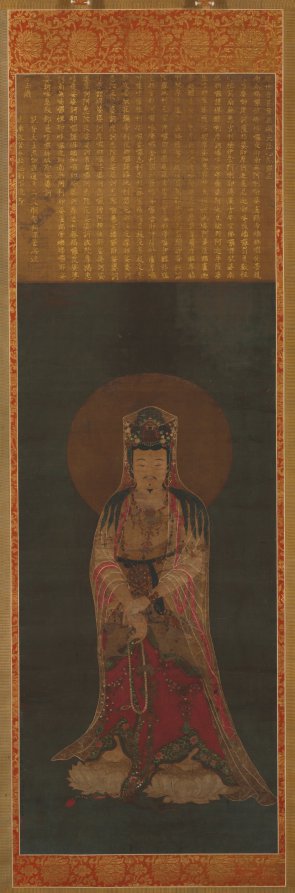
Kannon (c. 1868–1912) is in the Cleveland Museum of Art collection.
The work and its context
The museum's open-access catalogue describes the work:
The bodhisattva Avalokiteshvara (Kannon in Japanese) stands with each of his feet upon a lotus blossom. The Buddha Amitabha (Amida in Japanese) appears in his headdress. The text written in golden characters attached to the top of the painting is a portion of a religious text extolling the virtues of the bodhisattva. The painter was inspired by Buddhist paintings of the Korean Goreyo period (918–1392); he attempted to reproduce the diaphanous shawl sometimes seen in such early works.
Object facts
- Title: Kannon
- Date: c. 1868–1912
- Culture: Japan, Meiji period (1868–1912)
- Type: Painting
- Technique: hanging scroll; ink and color on silk; inscription in gold ink on silk
- Dimensions: Overall: 227.9 x 75 cm (89 3/4 x 29 1/2 in.); Painting only: 155 x 51.4 cm (61 x 20 1/4 in.)
- Collection: ASIAN - Hanging scroll
- Department: Japanese Art
- Accession number: 1986.8
Collection credit
Severance and Greta Millikin Purchase Fund
Further reading listed by the museum
- Turner, Evan H. “The Year in Review for 1986.” The Bulletin of the Cleveland Museum of Art 74, no. 2 (February 1987): 38–79.
- Cunningham, Michael R., Stanislaw J. Czuma, Anne E. Wardwell, and J. Keith Wilson. Masterworks of Asian Art. Cleveland, OH: The Cleveland Museum of Art, 1998.
- Fishbein, Richard. "Collecting Kannon." Impressions: Official Publication of the Ukiyo-E Society of America 35 (2014): 177–179.
View the collection record
See the museum's photographs and full catalogue entry. Catalogue text is reproduced from the Cleveland Museum of Art's open-access data, with HTML formatting removed. This object and its supplied image are designated CC0.
Sources
More in Lifestyle
Keep reading